Wednesday, August 29, 2018

Non-resident Nepalese Association (NRNA) USA Oregon Chapter & Nepali Association of Oregon (NAO) Organize Interaction on "Current Nepalese Politics and Diplomacy" in Portland, America

Dr Rabin Man Shakya


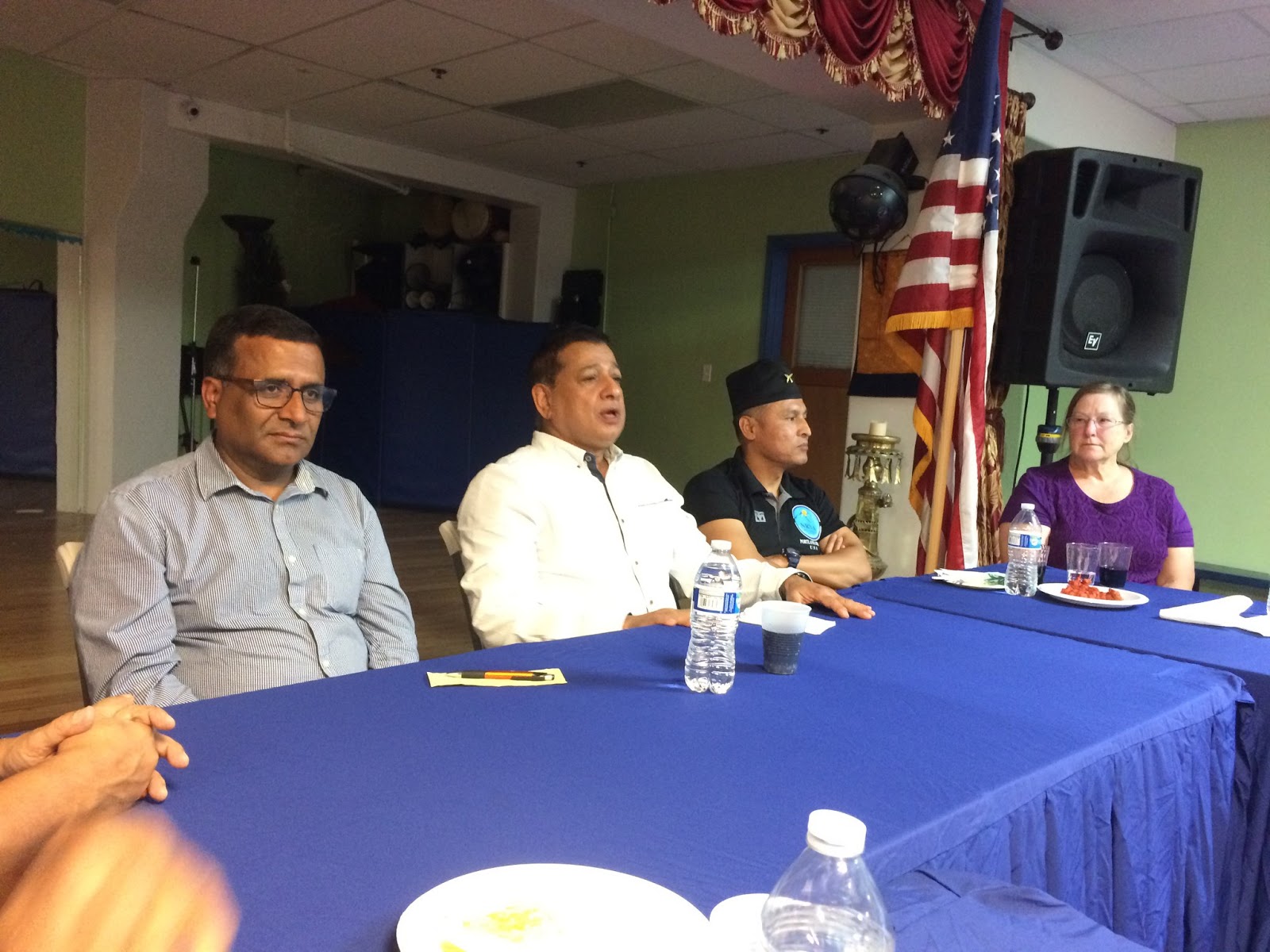
Portland, Aug 29 (Nepal Oregon News): An interaction program with Bal Bahadur Kunwar on "Current Nepalese  Politics and Diplomacy" was organized on Tuesday Aug 28, 2018 at Nekusing Memorial Theater(West Coast Taekwondo Hollywood) in Portland jointly by Nepali Association of Oregon (NAO) and Non-resident Nepalese Association, USA's Oregon Chapter.

Kunwar who is a Nepali Congress party leader is former Nepali ambassador to Sri Lanka and Pakistan. Similarly, he was also the member of parliament of Nepal.


Welcoming the guests, president of NAO Bharat Banskota expressed the view that the interaction program will benefit the Nepalese Portlanders to better understand the ongoing political situation in Nepal.

Speaking on the occasion, diplomat and politician Mr Kunwar said that there is a tremendous role of diplomacy in keeping up detente.

Similarly, talking about Oregon's contribution to Nepal's development efforts, Kunwar threw light on Oregonian Prof Dr. Hugh Wood's role in upgrading Nepal's education system in 1960s.

Pointing to disputes between the countries in South Asia, Kunwar said regional problems and disputes must be solved by diplomacy, not by confrontations.

Speaking about the political instability and economic backwardness of Nepal, Kunwar said the political actors of Nepal should be clean and honest to the people.

When it came to the geo-political situation of Nepal, Kunwar said that Nepal should be able to take benefit from being a transit point  between two of the ten largest economies in the world.

Addressing the gathering, Kunwar said that the political parties and politicians should rise above the petty partisan interests and get down to real soul-searching for finding ways to improve the life of the ordinary Nepalese  people.

Underlining the importance of young, educated and energetic politicians of the nation, he gave an example of Denmark where majority of politicians are young.

He expressed the view that destiny has driven Nepal to assume the role of a yam between two big stones, that is why Nepal should be able to carry out balanced diplomacy with India and China.

Mr. Kunwar called upon the Nepalese Portlanders and NRNs to mobilize resources and expertize for the development of Nepal.

At the end of the interaction, Mr. Kunwar answered the questions of the participants. Replying to a question of a journalist from Nepal Oregon News, Mr Kunwar said:"World peace, friendship among nations and peoples' solidarity are very essential to make the world a safe place to live." He then added that peace and diplomacy must always prevail over violence and intolerance.

Most of the questions of the participants were focused on how Nepalese living in different countries of the world can help in the development of Nepal.


The participants included the representatives of NAO, Nepa Chhen,  NRN-USA-NCC Oregon  chapter, Nepal Oregon News and other Nepalese living in Portland and its periphery.


Delivering vote of thanks, president of NRN-NCC-USA Oregon chapter  as well as the owner and director of Hollywood Taekwondo School Diwakar Maharjan said that just as NRNs investments are important to Nepal's future, an engaged NRNs are vital to our prosperity too.

Speaking about NRNs, Maharjan underlined the need for separate lane for Nepalese holding foreign passports at the arrival department of the Tribhuvan International Airport in Kathmandu.


(Nepal Oregon News writer Rabin Man Shakya is a Nepali journalist in America)

Monday, August 27, 2018

First Ever Nepali Buri Janko (Bhimratharohan) of a Newah Personality Organized at Nritya Mandala Mahavihara in Portland, USA

Maha Manjushree Naam Sangiti Recited 


Dr. Rabin Man Shakya


A senior age "Janko" religious ceremony of Maa Padma Laxmi Karanjit was held at Nritya Mandala Mahavihara, Portland on Friday, Aug 2018.

Ms. Padma Laxmi is the mother of Pramod Karanjit, who is the general secretary of Nepa Chhen, a non-profit organization of Nepali community in Oregon and who is also the co-owner of the Indian restaurant "Namaste" in downtown Portland.


It is to be noted that this is the first ever Newah style Bhimratharohan of a Newah personality  ritualized at a Newah Buddhist temple and by a Vajracharya Guruju in the USA.

(Meanwhile, some observers have falsely and wrongly claimed that Uma Sthapit's Buri Janko is the first ever in the USA. Make no mistake: Padma Laxmi Karanjit's Bhimratharohan was held long before Uma Sthapit's. Just for the record, an American couple's Bura Buri Janko was held even before the janko of Padma Laxmi. Pundit Prajwal Ratna Vajracharya of Nritya Mandala Mahavihara, Portland who ritualized and solemnized all those Janko ceremonies can confirm about it.) (Details added on 01-14-21)

Similarly, on the same day, the bratabandha ceremony of Pramod's son Dennis Karanjit was also held at the Vihara in Portland.


Janko rituals of Maa Padma Laxmi and bratabandha rituals of Dennis were performed by Guruju Prajwal Ratna Vajracharya at Portland's  Nritya Mandala Mahavihara which is the only Newah style Buddhist temple in the USA.

Janko related rituals such as Homa Puja, Nag Puja, Kalash Puja and Bali Puja were ritualized by Prajwal Guruju including the Bratabandha Puja. Likewise, Baran Chhuyegu and Sagan Bigu rituals were also performed on the occasion.


The Bajrayana Buddhist Tuta hymns like Dashparamita, Stuta Mapi, Maha Manjushree Naam Sangiti and Bandeshree were also performed by Daya Ratna Shakya, Pradeep Bajracharya and Rabin Man Shakya on the occasion.


The religious ceremony of the Janko and Bratabandh at Portland's Nritya Mandala Mahavihara is a testimony to the fact that the Nepalese Portlanders are keen to preserve the traditional and ritual values of the Newah culture.


 One of the very important ritual part of Janko ceremony is the parading of the honored person around the vicinity in a large procession. So, Maa Padma Laxmi was once again treated like a bride and was carried on a colorful chariot-like vehicle around the streets of Portland close to Nritya Mandala Mahavihara. The Janko parade  with Newah style Dhime baja music was accompanied by Guruju Prajwal, honoree's family members and a a lot of  Nepalese Portlanders as well as guests coming from Canada.


According to Prajwal Guruju, "When a man or woman turns 77 years, 7 months, 7 days, and 7 hours, there is a special ceremony to perform. The Janko observance calls on the Goddess of long life - Usnisavijaya - to purify Karma and bestow the blessing of good health and long life span."

Ms. Padma Laxmi Karanjit, who was born on October 31, 1938, came to the United States several years ago because one of her sons, Pramod, and one of her daughters, Bijaya, had been living in the US for almost 15 years.


When Maa Padma Laxmi was asked to shed light on her Janko celebration, she said "This is a gift of my rebirth and ascending the chariot - the Bhimaratharohan - riding the great vehicle of success in life by following the traditional ritual."


A gala dinner reception of Janko as well as Bratabandha was organized the next day, August 25, 2018, at the hall of German American Society in Portland.


Daya Shakya, vice president of World Newah Organization threw light on the importance of Janko ceremony at the program which was conducted by Sagar Sharma from Calgary, Canada.

A number of Newah dances were also presented on the occasion which was attended by hundreds of guests including the office bearers and representatives of Nepali Association of Oregon (NAO), Nepa Chen and Non-resident Nepali Association of USA, Oregon Chapter and Nepal Oregon News. A slide show depicting the life of Maa Padma Laxmi was also presented on the occasion.


(Also, please read an article entitled "World Newah Organization - WNO - and the issues of Newah unity" published in the Nepal Oregon News on Dec 25, 2024.) 


Sunday, August 19, 2018

Role of Nepa Chhen in Portland's Nepali Community in USA

Nepa Chhen, a nonprofit in Portland, was established in 2012 

Dr Rabin Man Shakya


Portland, Aug 19 (Nepal Oregon News): In Nepal Bhasa, which is the language of the Newah people of Nepal, Nepa Chhen means a Nepal House. Nepa Chhen is the outcome of the lofty ideas of some enthusiastic Nepalese community members in Portland to create a permanent house for community events, focus on culture, language, sports activities etc. It is to be noted that Nepa Chhen was established in November 2012 in Portland under the chairmanship of Rajesh Maharjan.


Dissemination and development of Nepalese culture, language and literature is the prime concern of Nepa Chhen. Its establishment six years ago was guided not only by the objectives of promoting language and literature among  the community but also by creating a forum that provides authentic information to the local Americans about rich Nepalese arts and culture. Thus, Nepa Chhen intends to build a cultural bridge between the Nepalese and the American people.


Nepa
 Chhen


champions the cause of enhancing and enriching the cultural and linguistic activities and will be instrumental not only in implementing its stated objectives, but will also present its credentials as a uniting force of the Nepalese community in Oregon. Raison d' etre of the Nepa Chhen is the growing awareness  of the community to preserve its identity, culture and traditions and this probably is Nepa Chhen's quintessential aspect. We should never forget that the name, objectives and motto of an organization define its identity.


It goes without saying that an organization like Nepa Chhen gives a true identity and uniqueness to the local community and that the community members interact with each other. And, yes, there is no doubt that the culture, traditions and customs of the people are determining factors in identifying the plans, programs and objectives of a non-profit community organization like Nepa Chhen.

Since its inception, Nepa Chhen has been carrying out programs like Mha Puja, Nepal Sambat, Bijaya Dasami, Lhosar, Vikram Sambat and summer picnics and so on, but local observers feel that Nepa Chhen, apart from these activities should also rise above them and genuinely get down to the business of accomplishing its mission. Local observers, however, feel that there is a little bit of slackness in the momentum. If the local Nepalese community leaders in Portland really want to build a permanent house for community events, they should make it a top priority, they must do some soul-searching about an infusion of new blood in the organization.


The remarkable programs which were organized by the Nepa Chhen in 2017 included, among others, the concerts of Ani Chhoying and Anju Pant. In fact, the past year has been one of the years with energy, enthusiasm and growth, but local community observers are not seeing anything coming out this year so far.


The challenges facing Nepa Chhen are indeed formidable since it has to carry out so many activities apart from building a permanent house for the community. Despite financial constraints, Nepa Chhen has been carrying out some publicity projects, such as, publication of newsletter and distribution of Nepa Chhen calendars etc. These  are some of the things which can be termed as a modest feather in Nepa Chhen's cap.

Nepal's culture offers a wide spectrum in terms of cuisines, utensils, attires, ornaments and musical instruments, just to mention a few. Nepa Chhen therefore should be able to organize exhibition of Nepalese food festivals. It should promote Nepal's languages and literature by organizing language classes whenever possible by holding seminars and symposiums on culture and festivals. Nepa Chhen should be able to inculcate values of culture, language and traditions on new generations.
Since the success of Nepa Chhen will depend not only on generous financial donations of different individuals and organizations, but on its right policies, vision and strategies too, therefore its future moves and modus operandi should be based on ground realities to suit the changing time and circumstances.

Even couple of decades ago, different Nepalese festivals being observed in various cities of the US and other countries was unimaginable. Today, for example, Yenya Punhi is celebrated in various US cities with Pulu Kisi dance, masked Lakhey dance, Kumari chariot procession with Dhime bajan. Even in the 1980s, I was in the former Soviet Union in cities like Minsk, Odessa and Donetsk where the Nepalese students had established Nepali Students Associations and used to celebrate occasions like Bijaya Dasami and National Democracy Day performing various Nepalese songs and dances. For me, it is just a deja vu that we have community organizations like Nepali Association of Oregon and Nepa Chhen in Portland, Oregon.  Today the rapid process of globalization and development of technology have turned the whole world into a small global village.

It is a matter of great satisfaction that in the past Nepa Chhen celebrated group Mha Puja and Nepal Sambat New Year  with big enthusiasm and much fanfare and hopefully this tradition will continue in the future too. It is to be noted that Nepal Sambat - a national lunar calendar of Nepal - kicked off in 879 AD during the rule of King Raqhav Dev to commemorate the reimbursement all the debts of the Nepalese people by a Newar trader Shankhadhar Sakhwa who was declared a national hero of Nepal on Nov 18, 1999 by the then His Majesty's Government of Nepal.
Although Nepal Sambat was declared  a national era of Nepal in 2008 AD by the government of Nepal, this Sambat has still not been given full recognition and not been used for all practical purposes in Nepal. Thus, Nepal Sambat New Year should be celebrated in Nepal and various parts of the world to remind the government of Nepal to respect and give  due recognition to it.
Celebration of Nepal Sambat in Nepal and in other countrieis of the world is a chance for the advocates of Nepal Sambat to raise voice for bringing Nepal Sambat into use as Nepal's official national calendar, and remind the government of Nepal that Nepal Sambat be declared a public holiday, Nepal Sambat be printed on banknotes and coins.

Nepal Sambat was grossly neglected not only during the rule of Rana oligarchy but during the 30 years period of Panchayat regime too. Even today after the declaration of Nepal as a federal Republic, Nepal Sambat has not been given full state level honor and recognition that it deserves. In such conditions, the advocates of Nepal Sambat should  leave no stone unturned to voice their opinion in rational and convincing manner, should strive  to build the broader public opinion for its cause. They should make optimum use of media, digital media as well as social media for making a convincing case for it.

Overall, there is a sense that despite all the gains (Nepal Sambat being declared national era, all of Nepal's languages being declared national languages, Shankhadhar Sakhwa being declared hero of Nepal and and being commemorated in stamps, road signs in Kathmandu being posted in Nepal Bhasa, all major mainstream daily newspapers of Nepal mentioning Nepal Sambat date below the masthead) in recent decades, Nepal's political, social and economic trajectory is still highly uncertain. It looks like even after the ouster of monarchy and after the launching of federal democratic governance, the people of Nepal are still disillusioned with the modus operandi of the mainstream political parties.


However, the forthcoming fourteenth anniversary of the Nepa Chhen in November 2026 will be a solemn occasion for the Nepalese in Oregon to reaffirm our commitment to preserve and safeguard  Nepalese culture and traditions. Thus, launching of the Nepa Chhen six years ago epitomizes the eagerness of Nepalese community members in Portland and beyond to create a permanent forum for community events, to focus on culture, festivals and traditions.


Therefore, judging by the past performance and activities, it is evident that Nepa Chhen is a formidable force in the Nepalese community in Oregon and it is hoped that the scope and role of Nepa Chhen is getting to be vital once again.


(Rabin Man Shakya is a Nepali journalist in America)


Friday, July 20, 2018

Our Life and Traveling

Rabin Man Shakya

Human life is full of vicissitudes, it is full of predictable as well as unpredictable events and happenings. But life is given only once and we should live the life.When I was a teenager, I never imagined that ten years of my life would be spent in Russia, and now I have been living in the United States for last 16 years.

Traveling is one of the productive  and creative part of human life. Everybody loves traveling. In his or her life, everybody has travelled in his or her own way. It is just some people have only travelled places in their own country while others have been able to make it to many countries.

It is always better to see something with your own eyes than hear or read about it several times.

I am not a globe-trotter but I have also travelled a lot in the past and it looks like I have been to more than 30 countries of Asia, Europe and America. Traveling has humbled me and has broadened my perspective in so many ways.

When I tell my American friends that I even happened to be in countries like Lithuania, Latvia, Georgia, Uzbekistan, and Moldavia, it is quite unbelievable for them. Well, while studying journalism at the Belarusian State University in the 1980s, I was able to make trips to different places of Russia, Ukraine, Belarus, Moldavia, Uzbekistan, Lithuania, Latvia and Georgia.

We all have a story to tell. In both our personal and professional lives, we have experiences that would provide more than enough opportunity to fill volumes of books. Some of our individual stories might read like a comedy, some would be like a drama, perhaps for others, more like a mystery or a conundrum.

(Rabin Man Shakya is a well-known Nepali journalist in America)

Saturday, June 30, 2018

Bhimratharohan an Important Ritual in Newar Culture

Bura-Buri Janko of American Couple at Nritya Mandala Mahavihara in Portland, USA


Dr Rabin Man Shakya


Portland, June 30, (Nepal Oregon News): Newah-style Bhimratharohan or Junko taking place in Portland, USA? That must be a big cultural event for Nepalese community in Oregon. The event becomes more newsy when you come to know that the Bhimrotharohan couple is not from Nepal but from the US.

The Bhimratharohan of Mr. Marcus Thomas and Mrs. Betty Durham performed at Nritya Mandala Mahavihara in Portland on Monday, June 25, 2018 as per the Bajrayana Buddhist rituals was an unprecedented and unique event in Portland, Oregon. When I say this is the unprecedented and unique event, I mean to say that this is the first Bhimratharohan of a  couple from the US performed in a Buddhist Mahavihara by a Buddhist Guvaju in the USA.

Bhimratharohan rituals of Marcus and Betty were performed by Buddhist Guvaju Prajwal Ratna Vajracharya of the Nritya Mandala Mahavihara in Portland. Present at the Bhimratharohan ceremony were the Americans as well as Nepalese Portlanders.


One of the very important ritual part of the Bhimrath ceremony is parading of the honored couple around the vicinity in a large procession. So Marcus and Betty were once again treated like a bride and bridegroom and were carried on a colorful chariot-like vehicle around the streets of Portland close to Nritya Mandala Mahavihara.


Talking to a journalist from Nepal Oregon News, Buddhist Guvaju Vajracharya said: "When a man or woman turns 77 years, 7 months, 7 days and 7 hours, there is a special ceremony to perform. The celebration may also be held for a couple when either the husband or wife reaches that age. The Bhimrath observance calls on the Goddess of long life -Usnisavijaya- to purify Karma and bestow the blessings of good health and a long life span."

When Prajwal was asked to throw light on the Bhimrath ceremony, he went on saying: "At the culmination of the Bhimrath festivities, the honored person or couple dressed in brocade raiment is paraded through the streets in a chariot (ratha) drawn by their children and grandchildren and feted with music, flowers, sacred water, vermillion powder and incense."

"The honorees' ears are pierced for the second time and their youngest grandchild places new silver earrings in their ears. Henceforth, they are released from religious and ritual obligations, for their sins have been remitted and their Karma purified," says Portland-based Buddhist priest Prajwal.

Well, little is known about the ritual significance of Bhimratharohan. So when I asked Prajwal to describe about it, he revealed that "the honored individual or couple ride a chariot drawn by flying horses, the magical steeds that would transport   them to paradise or to Nirvana, the afterlife destinations secured by the Bhimratha ceremony. The Newah priest overseeing the ceremony seals the blessings by performing a Homa Puja."

There is no doubt that Nritya Mandala Mahavihara has been playing a tremendous role to enhance Bajrayana Buddhist customs and traditions alive in the US. In fact, this is so far the only one Bajrayana Buddhist Temple in the USA.

 The Mahavihara which was established in 2009 in Portland by Prajwal Vajracharya and Helen Appell is also a study center  which includes the temple and a library and focuses on movement, sacred arts, meditation and teachings for anyone interested in devoting practice to reveal their nature.

The auspicious wedding, rice feeding ceremonies, Ihi ceremony, Bara Tayegu ceremony, Brata Bandha or Chuda Karma of local Nepalese Portlanders have also been performed at the Nritya Mandala Mahavihara from time to time.

Likewise, the Mahavihara serves as a major institution in the preservation, expansion and exploration of all Newar Buddhism and Newar culture.

Photos: Courtesy of Pradeep Bajracharya and Selina Shakya


(Rabin Man Shakya is a Nepali journalist in USA)

Sunday, June 10, 2018

Sithi Nakha Festival: Newah Environmental Day

By  Dr Rabin Man Shakya


Portland, June 10, (Nepal Oregon News): Today is Sithi Nakha, a big cultural festival of the Newah people,
that falls on the sixth day of the waxing moon in the month of Tachhala Thwo, Nepal Sambat 1141, a lunar calendar. Sithi Nakha is a popular Newah festival that is celebrated right before the start of Monsoon season in Nepal.

During the Dharani recitation in the zoom today, Guru Prajwal Vajracharya of Portland's Nritya Mandala Mahavihara also delivered a short talk on the culture and traditions of Sithi Nakha.

Stating that Newah people observe Sithi Nakha by eating Wo mari on this day, Guru Prajwal said that three different kinds of Wo mari were prepared by him for limited number of participants.


Home-made Wo


Newah people living in Nepal as well as living in different countries of the world celebrate Sithi Nakha by cooking and eating "Wo" mari (Fried lentil pancake). 

Meanwhile, Newah Cultural Society of Alberta (NCSA), Canada organized a special cultural event at Duggan Community Hall in Edmonton on June 16, 2018 to celebrate the Sithi Nakha and Bungdyah Jatra whereas Newah Organization of America  (NOA) Seattle Chapter observed the Sithi Nakha in community level by organizing a picnic.

Our family in Portland, USA also celebrates Sithi Nakha every year by making "Wo" mari on this day. It is to be noted that "Wo" mari contains high amounts of proteins, carbs, iron and other nutrient values.

Taking a trip down memory lane, I remember in the 1960s and 1970s (that was before going to the USSR for ten years and to the USA for good),  my late grandmother Ratna Devi Shakya and my late mother Man Shova Shakya used to make different kinds of "Wo", such as, May Wo, Moo Wo, Kasu Wo etc. But here in Portland, we have to live with Moo Wo and sometimes with May Wo too. During my childhood days, I still remember I frequently used to ask my late mom Man Shova Shakya "When is the 'Wo' eating day coming?" As children, we were always so excited to eat different kinds of 'Wo' on the day of Sithi Nakha.

In colloquial or conversational Nepal Bhasa, Sithi Nakha is known as Sinnakha. At least, that was how my late grandmother and mother used to call for what is the Sithi Nakha literally.


Mung lentils being soaked over-night for making Wo


For making Wo, one needs to leave the dried lentils to soak in water overnight. And then the fully soaked lentils have to be grinded or mixed in a grinder. Technology has made it much easier. But during my grandmother's days, making Wo was not that much fun. It was a very time-consuming process. At that time, the soaked lentils were squeezed and rolled manually in a firm stone slab with a stone roller.
Wo is ready! Any Takers? 

Of course, Newah families celebrate most of the Newah festivals, no matter where they live. They want to maintain Newah culture and Newah traditions and instill the Newah values on their children. They want to maintain the Newah identity.

Newahs and the Newah festivals are inextricably interrelated. When I say this, I mean to say Newahs and Newah festivals have symbiotic connection.

Nepal is the land of festivals and cultural carnivals. Festivals are important factors that enliven the Nepalese culture. When I say festivals are important factors that enliven the Nepalese culture, I mean Nepal is just famous and well-known across the world for its rich culture and festivals, among other things. Nepal's identity is deeply interrelated to its arts, culture, traditions and festivals, so to say.

There is no doubt that Sithi Nakha is the Newah version of World Environment Day (WED). Except, Sithi Nakha has been celebrated by the Newahs in Nepal for centuries while celebration of WED is totally a recent phenomenon.

This festival is the profound expression of devotion and commitment to the Earth. The planet Earth is  round in shape and the Wo mari offered to the planet Earth on this Day is also round in shape. I am so glad to know that lately the Nepal government has been carrying out different cleanliness and other environment awareness programs to mark the Day.

Sithi Nakha for Newah people is very important because it is on this Day the Newahs not only clean and sweep their homes,  nearby surroundings, Nanis, Gallis, Bahals, they also purify, clean and mop wells, ponds, stone spouts, springs and other water sources in the neighborhood periphery.

Sithi Nakha is also the Day when Lord Varah is worshipped. Hindu Newahs celebrate this festival as the birthday of Kumar Kartikeye, son of Shiva while Buddhist Newahs observe it as the Mahaparinirvana Day of Prince Mahasatwo of the state of Panti.

According to the chronicles, Maharath and Satyabati were the King and Queen of state of Panti. Their sons - princes Maha Dev, Mahaprasad and Mahasatwo went for hunting at the Namo Buddha hills (then Gandhaman mountains).  While the elder brothers Maha Dev and Maha Prasad were busy chasing and capturing wild animals, young Mahasatwo confronted a pregnant tigress on the verge of dying due to hunger. The young prince was so overwhelmed, moved and emotional that he cut parts of his body to feed the dying tigress.

Later, when the elder brothers started looking for Mahasatwo, they found out remnants of the bones and also confronted the well-fed tigress. To pay tributes to the great soul, King Maharath erected a Boddhist chaitya on the Namra hills in 974 Kaligat Sambat.

According to the chronicles, Tathagata Bhagwan Buddha was in Namra hills to pay tributes to the great soul. The Shakya Muni chanted "Namo Buddha"  while paying tributes to Mahasatwo. Ever since, the Buddhist stupa is known as Namo Buddha. While still in Nepal, I remember  with great fondness the moments of our family's visit to Namo Buddha stupa situated at the picturesque Namra hills.

It is to be noted that on the day of Sithi Nakha, the Newahs of Kathmandu Valley also chant religious hymns to commemorate the sacrifices of Prince Mahasatwo.

Nonagenarian cultural expert and Man of Century Satya Mohan Joshi was quoted as saying in a Nepalese newspaper that the Newah community celebrate Sithi Nakha by cleaning water sources like wells, ponds and stone spouts and ending it with a grand Newah feast of six different varieties of Newah foods including Wo and Chatamari (Newah pizza).

The traditional significance of Sithi Nakha lies in the fact that it inculcates on the people the value of conserving water sources and keeping them clean and this has been practiced  for centuries.

It goes without saying that culture, traditions and festivals which are the embodiment of the nation and national glory are always in need of preservation and protection.


(Rabin Man Shakya is a Nepali journalist in USA)

Sunday, May 6, 2018

World Press Freedom Day Observed in Nepal

Dr Rabin Man Shakya
Former President, Nepal-Russia Press Center.

World Press Freedom Day was marked in Nepal and in other countries of the world on May 3, 2018 with different programs and rallies.

According to media reports, World Press Freedom Day (WPFD) was celebrated in Kathmandu and other parts of Nepal by organizing different programs. To mark the occasion, a huge rally was organized on May 3, 2018 in Kathmandu too.

It is to be noted that May 3 was proclaimed World Press Freedom Day by the United Nations General Assembly in 1993 following a recommendation adopted at the 26th session of UNESCO's General Conference in 1991.

Well, Nepal marked the WPFD with different kinds of intimidations and assaults on journalists reported throughout the country over the past year.

Even though  today Nepal is a federal democratic country and press freedom was enshrined into the constitutional preamble, intimidations and attacks on Nepalese journalists are on the rise. In the past several years a number of Nepalese journalists were killed.

According to 2018 World Press Freedom Index, not without reason, Nepal has slipped six spots down to the 106th position compared to last year's ranking among 180 nations.

Going by the World Press Freedom Index, the Himalayan nation garnered 32.05 points whereas it was ranked 100th with 33.02 points in 2017.

Therefore, celebration of WPFD is very relevant for Nepal and the Nepalese journalists. This Day reminds us that we should attach more importance to safety and protection of the journalists. There were many cases in the past that the killers of the journalists went scot-free in Nepal. As a matter of fact, impunity has affected press freedom globally and there should be coordinated efforts to put the culture of impunity to an end.

Nepal is no more a kingdom, no more King Gyanendra's idiosyncrasies, no more repressive Panchayat regime. But despite the fact that scenario of press freedom is improving, nevertheless, assaults on journalists are also increasing alarmingly.

Journalists in Nepal like in many other countries are also a vulnerable lot. They brave difficult situations while protecting public interest but the question is: who protects them? A number of journalists suffer intimidations and physical assaults because of what they write.

Celebration of World Press Freedom Day is an opportunity to uphold the fundamental principles of press freedom, to defend the media from assaults on their independence and to pay tributes to journalists who have lost their lives in the line of duty.

Taking a trip down memory lane, when I was still in Nepal and was the president of Nepal-Russia Press Center, the Center had also organized a program to mark the World Press Freedom  Day on May 3, 2002 at the Russian Cultural Center in Kathmandu.

Director of Russian Cultural Center Vladimir P Ivanov, journalist Dr Rabin Man Shakya and Dil Ratna Shakya of Nepal-Russia Chamber of Commerce and Industry, among others, had thrown light on the significance of the World Press Freedom Day.


In Vajrayana Buddhism, a Dakini is the Ultimate Personification of Fierce Feminine Wisdom: Prajwal Vajracharya

Four-week Teaching Course on 'Embodiment of the Dakini Praise' Wraps Up Rabin Man Shakya Portland, Sept 20 (Nepal Oregon News): A fo...