Monday, May 23, 2016

Non-resident Nepali Association (NRNA) USA Oregon Chapter Hosts Nepalese Ethnic Fashion Show in Portland, America

Preservation of Traditional Nepalese Ethnic Attires Emphasized

Dr Rabin Man Shakya


Portland, May 22 (Nepal Oregon News): An ethnic fashion show depicting dresses of various ethnic communities of Nepal was organized here on Sunday, May 22, 2016 at Nekusing Memorial Theater, (US West Coast Taekwondo Hollywood) Portland by the Non-Resident Nepalese Association, National Coordination Council USA Oregon chapter.

It was an endeavor of the NRN-USA Oregon chapter to give Portlanders a glimpse of traditional ethnic attires of different Nepalese communities.

It was the first ever Nepalese ethnic fashion show in Portland participated by the Nepalese as well as Americans. Participants included Nepalese and Americans from age 10 to 60 years old. Sincere and collective efforts of NRN-USA Oregon chapter, fashion show coordinators, enthusiastic participants and volunteers are certainly very commendable and praiseworthy. 

It was a fashion show, but there were no designers, no judges, no competitions and no awards and prizes. In fact, it just was a part of a strategy of NRNA - Oregon chapter to just provide a glimpse of multi-ethnic apparels of various indigenous communities of Nepal.

It was just an honest endeavor of NRNA-Oregon Chapter to promote and enhance Nepalese ethnic cultures and traditions, as well as to bolster and boost the community value about various  ethnic cultures of Nepal.

Quite fascinating and amazing were the American boys and girls wearing different attires of various ethnic communities of Nepal.

National anthems of Nepal and United States were played at the beginning of the ethnic fashion show.

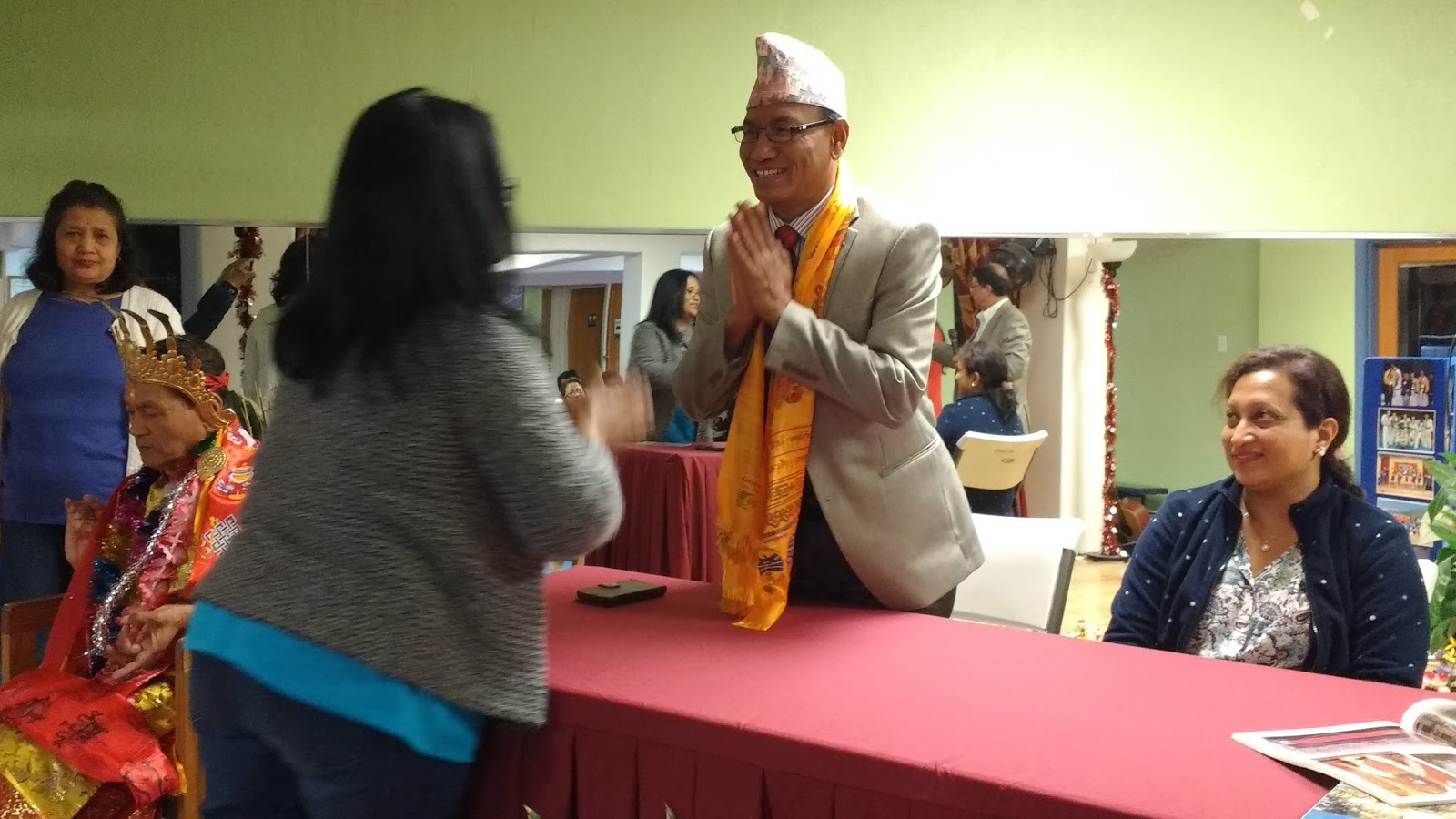
On the occasion, coordinator of the ethnic fashion show Sita Rai wrapped Khada on chief guest Govind Giri Prerana, NRN-USA Oregon chapter president and noted taekwondo instructor Diwakar Maharjan, president of Nepali Association of Oregon Ganga Sharma and president of Nepaa Chhen Rajesh Maharjan.

Chief guest of the ethnic fashion show was Govinda Giri Prerana who expressed the view that there are many unique features in the dresses of multi-cultural and multi-ethnic nation like Nepal. Preservation of these traditional attires is very important, he said.

President of Nepalese Association of Oregon Ganga Sharma expressed the hope that the American guests would be able to get some glimpses of Nepal's culture at the fashion show. But she advised them to visit Nepal to see rich arts and cultural heritage with their own eyes.

Newar traditional dresses and Haku Patasi were displayed on the occasion by Jaya Shakya, Naveena Shakya, Steve, Sagen, Prabin, Chris, Yougen and Dennis. Parsi, Gaa (shawl) and jewelry displayed by them are used by the Newar women in the  Kathmandu valley for attending traditional receptions like wedding feasts, chuda karma, junko bhoe (rice feeding ceremony) etc.


Haku Patasi, Chholo, Patuka, Mwa kashi, Jyapu, Tapalan and Black Cap were displayed by Palistha Shakya,  Sagen Maharjan, Prabin, Chris, Yougen, Steve Neku Maharjan and Dennis Karanjit.


The traditional attires of the Newah people are some of the richest part of the heritage of the Nepalese culture. Tapalan, Haku Patasi, Sayan Kayeta, Parsi, Bhantalan and other ceremonial dresses are some of the distinct costumes of Newah people in the Kathmandu valley where traditional weaving was a part of Newah people's life in the past centuries.

Similarly, Bhojpuri dresses were exhibited on the occasion by Quincey Dunlap (Grant High School) and Pradeep while Dhimal outfits were presented by Selba and Benit.

Likewise, Sophie and Surjendra performed on the Gurung robes while Bella and Seth walked through with Tamang costumes. Brahmin dresses were displayed by Pabi and Ramesh. Similarly, Neli and Bikram walked through in Newar bridal dresses.


Sherpa apparels at the program were displayed by Pemba, Kilu, Prabha, Kebin and Nawang Sherpa whereas Magar dresses were shown by Minu Mali and Rai attires by Asmita and Pasang. The guests at the program were able to see Sherpa dresses like Bakkhu, Docha, Lukani, Pangen and Magar attires like Lungi, Mugiya, Cholo Makhamal, Ghalek etc.


The audience also got an opportunity to witness Bhojpuri clothes like Dhoti, Kamij, Kurta,Bhangua and Jhuluwa, Gunyu, Cholo; and Tamang dresses like Cholo Makhamal, Patuka, Ghalek, Tiki, Sir Bandi, Half Bakhu, Full Bakhu, Tamang Cap Woolen Jacket, Shirt Silik Bhutani.

Dhimal outfits like Tepana, Aaskot. Ganji, Lokhan, Bonas, Cholo, White Shawl were also displayed by the participants at the show. Gurung dresses like Bhagra, Bhoto, Kachhod, Estakot Black, Topi Black, Lungi, Patuka Blue, Cholo Makhamal, Ghalek, Naugedi Janter etc were also shown to the audience. Likewise, Rai attires, such as, Pharia, Cholo (Dhaka), Patuka Dori, Chandrama, Bulaki, Jantar, Daura Suruwal, Dhaka Topi, Estakot etc were also demonstrated by the fashion show participants. Brahmin dresses Daura Suruwal, Patuka, Topi, Sari, Cholo, Mujetro were also displayed.

The fashion show was followed by a program of songs and dances. The show   was conducted by vice president of NRN-USA Oregon chapter Daya Shakya who expressed the view that Kathmandu has become a cultural melting pot of Nepal.

The fashion show was attended by representatives of Nepali Association of Oregon, Nepaa Chhen, NRNA-NCC-USA Oregon chapter and Nepal Oregon News and scores of Nepalese and American guests.

At the end of the program, certificates of participation were handed over to the participants of ethnic fashion show by chief guest Prerana. Certificates of appreciation were also given away to the volunteers.


(Rabin Man Shakya is one of the few Nepalese journalists in America)

Friday, May 13, 2016

Dharmaditya Journalism Award

Dr Rabin Man Shakya
President, Newah American Buddhist Association

Although there are journalism awards galore in Nepali language journalism,  "Dhuswan Bishwobhoomi Award" and "Dharmaditya Journalism Award"  are  the first and second  journalism awards in Nepal Bhasa journalism so far.  Dhuswan Bishwobhoomi Award  was given to late Nepal Bhasa journalist Elvis Joshi of the Sandhya Times daily newspaper. Well, there are quite a few other Nepal Bhasa awards too, but they are confined to Nepal Bhasa literature, arts and music.

Journalism awards work as a catalyst for journalists and reporters, inspire them to work with more vigor, more effectiveness and and with more zeal. For a long time, there has been a conspicuous absence of any journalism awards for Newah journalists.

"Dharmaditya Journalism Award" was founded couple months ago by Newah Journalists Forum, Lalitpur in memory of Dharmaditya Dharmacharya who was the first journalist of Nepal Bhasa. Commencement of these Awards definitely filled the void.

And it goes without saying that launching of journalism award by the Forum for the Newah journalists is a praiseworthy and commendable step. Sincere and dedicated efforts must be carried out so as to give continuity to these awards, because in Nepal a number of awards are announced but they   tended to fade away after couple of years.

At a time when a number of Nepalese literary and journalism awards were launched and named after deceased parents of the riche rich, the fact that this one is named after the first Newah journalist in itself adds a big significance of the award.

Not long ago, the first Dharmaditya Journalism Award was awarded to Nepal Bhasa journalist Suresh  Kiran Manandhar who is the chief editor of popular Nepal Bhasa daily newspaper "Sandhya Times".

This is a fitting acknowledgement of a journalist who for over last two decades has devoted himself as a true, sincere and dedicated Nepal Bhasa journalist.

Journalist Suresh Kiran who was born in 1967 is a graduate in journalism from the Ratna Rajya Laxmi Campus, Tribhuvan University.

Suresh Kiran who was also editor of Nepal Bhasa daily newspaper "Bishwabhumi" is also known as a poet and satirist.

Suresh Kiran is also a laureate of literary awards like Parijat Srijanshil Purashkar and Rastriya Pratibha Puraskar.

Likewise, journalist Suresh Kiran was also awarded with the Nationalities Indigenous National Journalism Prize - 2072 BS recently.

There is no doubt that Dharmaditya Patrakarita Shirapa is a glowing tribute to late Dharmaditya Dharmacharya who was the first journalist of Nepal Bhasa.

It is to be noted that "Buddha Dharma" was the first printed publication in Nepal Bhasa and it was brought out by Dharmaditya Dharmacharya which was nome de plume of Jagat Man Vaidya (1902-1963).

Due to lack of conducive political atmosphere to bring out publications in Nepal, the first Nepal Bhasa magazine was published in Kolkata, British India.

The first Nepal Bhasa magazine "Buddha Dharma" was morphed into "Buddha Dharma wa Nepal Bhasa " in 1927. The first Nepal Bhasa magazine devoted to the issues of Theravada Buddhism and problems facing Nepal Bhasa. It was an effective voice that was instrumental in inculcating values of language and giving a platform for struggle against repression of Theravada Buddhism.


* Dr Shakya is advisor, Nepa Chhen, Portland, USA
and also State Education Director, NRNA-NCC-USA, Oregon Chapter

Tuesday, May 10, 2016

Finally, Minimum Salary for Working Journos in Nepal is Rs 19,500

Rabin Man Shakya

The recent decision of the government of Nepal fixing the minimum wages of the journalists working in the private media sector as Rs 19,500 and subsequent statements of the associations of the media owners denouncing the government decision have underscored the vulnerable and susceptible relationship 'on the issue of wages  of the journalists' between media owners vs government and media owners vs working journalists.

Working journalists of Nepal have been demanding for fixation of minimum salary in the print and electronic media in the private sector for years. It looked like the genuine voices of the working journalists have fallen in the deaf ears of the authorities. A number of task forces and committees were set up within past two decades for fixing the minimum wages for the working journalists. Even the umbrella organization of Nepalese journalists - Federation of Nepalese Journalists (FNJ) -came under fire for its lackadaisical approach to the issue of minimum wages for the working journalists.

There is no doubt that the bold decision  of the government has come as a de facto victory for the working journalists of Nepal.

Meanwhile, the three associations of the media owners namely Nepal Media Society, Broadcasting Association of Nepal and Radio Broadcasters' Forum in a statement published recently have urged the government to rethink its decision on journalists' minimum wages.

The three associations of the media stalwarts said that the government decision would add a new constitutional crisis to the media sector, already rattled by the 2015 earthquake and economic blockade.

They also went on to say that the decision was taken unilaterally while discussions among stakeholders over the issue were yet to conclude.

It is true that Nepalese FMs and TV channels are facing a number of challenges that threaten the very survival of the media outlets (with the exception of NTV and few others) due to sharp decline in advertising revenue and increasing production costs.

Why do the journalists who are supposed to play watchdog roles end up in being the lapdogs of the politicians and tycoons? Why too many Nepalese Nepalese journalists  are playing sycophantic role in the Nepalese media industry? Apart from politicization and polarization of the media, the financial constraints are pushing  some journalists to become media lapdogs at the hands of political stalwarts and business tycoons.

Working as journalists and anchors in various Nepalese TV channels and FM radio stations sounds very great. But in reality it is nothing more than the superficial glamour and glitter of the tinsel town - that is Kathmandu. The Nepalese journalists continue to suffer because of underpayment and late payment of salaries. But it looks like the Nepalese journalists have been " sweetening the pill " by continuing to work for less money or even no money.

If one analyzes the problem in broader perspectives, it will be found that licenses and registration of newspapers, FMs and TV channels were issued haphazardly in Nepal without examining deeply into the actual financial status of the media organizations.

Here in the United States, the practice is totally different. For example, Portland is the biggest city in the state of Oregon, but there is only one regular daily newspaper "The Oregonian". It goes without without saying that journalists working in the newspapers, radio and TV channels in the US get very good salary.

However, the recent decision of the government to fix the minimum salary of working journalists is a right step in the right direction and the implementation of the decision should be made in an effective manner. Therefore, harsh penalties should be imposed on the media outlets which are found to be underpaying and not paying on time and which are found to be violating the recent government decision on minimum payment of wages to the working journalists.

Tuesday, May 3, 2016

NRNA-USA Oregon Chapter to Organize Fashion Show


By Rabin Man Shakya
State Education Director, NRNA-NCC-USA Oregon Chapter


In a bid to further popularize the Nepalese traditional dresses and give a general introduction of the attires of various ethnic communities of Nepal to the people of Portland, Oregon, the Non-Resident Nepalese Association, National Coordination Council USA Oregon chapter is going to organize  a fashion show on Sunday,  May 22, 2016 at Nekusing Memorial Theater, Portland.

This is the first time that a traditional fashion show -Nepal Ethnic Cultural Fashion Show- depicting dresses of various ethnic communities of Nepal is being organized in Portland.

The participants are to display costumes of various ethnic groups such as the Sherpas, Magars, Gurungs, Tamangs, Rais, Newars, Brahmins, Chhetris, Dhimals, and Maithili and Bhojpuris.

There is no doubt the culture of any country is reflected in the way of living and lifestyle of people. Traditional attires and apparels are an important component of the lifestyle of different ethnic communities.

In Nepal, there are different ethnic groups and communities which have its own customs, culture, tradition, food, utensils, ornaments, musical instruments and dresses.

Therefore, in economic terms, Nepal may be a poverty-stricken country, but in arts and culture there are reasons for Nepal to be proud of her cultural heritage and ancient arts.

Living in the same society, different ethnic communities must strive to preserve and safeguard their own culture and traditional dresses.

The fact that NRNA-USA-Oregon Chapter is organizing the Nepalese traditional and ethnic fashion show in Portland is a praiseworthy step in itself, but it is advisable for this organization to organize some more shows or festivals relating to Nepalese cuisines, utensils, ornaments, musical instruments, etc in the future.

I am, myself, a representative from the Newah community. Not being a fashion expert nor a trend analyst, I would say that it does not take an expert to understand the role and importance of preserving the attires of different ethnic communities. Any endeavor toward preserving, disseminating and displaying the rich and traditional attires of the ethnic communities is a welcome and commendable act.

The traditional attires of the Newah people is one of the richest parts of the heritage of the Nepalese culture. Tapalan, Haku Patasi, Sayan Kayeta, Parsi, Bhantalan and other ceremonial dresses are some of the distinct attires of the Newah people in the Kathmandu Valley, where traditional weaving was a part of Newah people's life in the past centuries.

Meanwhile, General Secretary of NRNA NCC USA Oregon Chapter Sunil Rajkarnikar says, "We are expecting to include all ethnic groups from Himal, Pahad, and Tarai to represent each group with costumes for respect of diversity among us."

Ms. Sita Rai of the NRNA-USA Oregon Chapter and Ms. Bidhya Gurung are designated as  the coordinators of the fashion show. 

Friday, April 29, 2016

Role of Nepal Bhasa Journalism in the Struggle for Linguistic Freedom

Dr. Rabin Man Shakya
President, Newah American Buddhist Association

Nepal Bhasa is the language spoken by Newah people whose culture, arts and rituals are one of the richest in the world. Arts, culture and languages are the important sources of identity of a nation. Arts, culture and languages are indivisible parts  of civilization and therefore there obviously is a symbiotic relationship between arts, culture and language. The culture of any country is reflected in the way of living and lifestyle of people. There are many ethnic groups in Nepal. Each ethnic group has its own language, customs, culture and traditions. Living in the same nation, they strive to preserve and safeguard their own languages and culture.

If we go by the assumption that language is a central component of cultural identity, then all the languages of Nepal should be duly honored and recognized, not just in papers and documents, not just in the rhetorical speeches of the ministers and political stalwarts.

As a matter of fact, suppression of Nepal Bhasa was started immediately after the advent of Shah dynasty in 1768 AD. It is to be noted that the coup d’ eat orchestrated by Jung Bahadur Rana in 1846 AD further paved the way for brutal and repressive hereditary Rana prime-ministership which lasted for more than a century (1846-1951). Except for the Mulki Ain, there were no press laws and regulations during the notorious rule of Rana generalissimo. More often than not, the words coming from the mouth of the Rana prime minister used to be the ‘law’.

It was during the period of Rana regime that a number of Nepal Bhasa luminaries, such as, Nistha Nanda Bajracharya, Siddhi Das Mahaju, Jagat Sundar Malla, Yogbir Singh Kansakar, Shukra Raj Shastri and Dharmaditya Dharmacharya started their revolutionary and creative literary activities for the cause of upliftment of downtrodden Nepal Bhasa.

In fact, Nepal Bhasa which is one of the historical and ancient languages was the administrative language of Nepal from  the 14th to the 18th centuries. Nepal Bhasa which is a major ethnic  language  of Nepal is spoken as a mother tongue by about 15 per cent of the people of Nepal. Nevertheless,  Nepal Bhasa was neglected and suppressed in different time spans of Nepalese history.

Actually, the history of Nepal Bhasa journalism is the history of its struggle for the due recognition of Nepal Bhasa, Nepal Sambat and Theravada Buddhism, the history of agitation and turmoil against the continuous repression. The history of  origin and emergence of the Nepal Bhasa press is profoundly inter-related with the activities of the Nepal Bhasa activists in British India. Nepal Bhasa journalism’s closed doors or cul-de-sac was opened for the first time in Nepal Bhasa journalism history with the publication of the magazine “Buddha Dharma” in 1925 AD from Kolkata, British India by Dharmaditya Dharmacharya. It was a landmark event in the chronicles of Nepal Bhasa journalism. Absence of conducive political conditions and specter of Rana regime’s repression - these were some of the reasons  that prompted some Nepal Bhasa advocates to embark on “magazine publication venture” in Nepal Bahasa not from within the territory of Nepal, but from abroad.

Therefore, the monthly magazine “Buddha Dharma” was the first printed publication in Nepal Bhasa and it was brought out in 1925 by Dharmaditya Dharmacharya which was nome de plume of Jagat Man Vaidya (1902-1963). In fact, “Buddha Dharma” was the outcome of the lofty ideals of some enthusiastic Newars in Kolkata, India like Dharmacharya to create a platform for reviving Theravada Buddhism and for promoting Nepal Bhasa as language of Newars.

It may be a coincidence or a planned event, but the first issue of “Buddha Dharma” was brought out on the day of Buddha Purnima. It was in 1927 that the name of the publication “Buddha Dharma” was morphed into “Buddha Dharma wa Nepal Bhasa”  thereby becoming an effective platform that accommodated interests of Theravada Buddhists and advocates of Nepal Bhasa.

So, what was the raison d’ etre  of “Buddha Dharma” being published from Kolkata, British India?  Press freedom and freedom of expression were the words that very few Newah elites could understand during the Shah-Rana regime.

What, palpably, made the Rana regime decide not to permit the people to participate in the linguistic, journalistic and social awakening activities was the specter that in due course of time, it would politicize and polarize the people to such an extent that a serious threat to their monopolistic and oligarchic regime might be posed.

Hence, the Newah people were not only deprived of press freedom and freedom of expression, but all those means of mass communication (such as newspapers, magazines, books, libraries, photography, radio sets etc) that might make them politically conscious of their legitimate rights were also prohibited to function or were controlled by the Rana generalissimo.

Speaking of the Rana regime, mention must be made of Chandra Shamsher Rana who was one of the cruelest and despotic Rana prime ministers. Chandra orchestrated untimely exit of Dev Shamsher who was relatively a liberal Rana premier and who started the publication of the Gorkhapatra in 1901. Likewise, mention should also be made of Gyan Mala Bhajan Khala which disseminated devotional songs and raised awareness against the Rana tyranny. It is to be noted that Gyan Mala Bhajan hymns were  usually written in Nepal Bhasa to enhance Theravada Buddhism, something intolerable to the Ranas. The activists of the Gyan Mala Bhajan Khala were  incarcerated and tortured by the  generalissimo during the reign of Chandra Shamsher. This was a testimony to the fact that the Rana rulers did not even tolerate the religious freedom, much less the social and political awakening.

The rituals, ceremonies and traditions of Bajrayana Buddhism practiced by the Shakyas and Bajracharyas of the Kathmandu Valley were allowed unhindered during the Rana regime. But the Ranas did not tolerate the religious activities of the Buddhist monks bolstering the Theravada Buddhism. As a result, a number of Nepalese Buddhist monks were banished from the country.

Given the fact that even the first and pioneering publication in the Nepali  or Gorkhali language (which has always been the official and national language of Nepal during the entire Rana and Shah rule) “Gorkha Bharat Jeevan” was printed and published  in Banaras, British India in 1888 AD, it is not surprising to note that the first publication in Nepal Bhasa was also launched not from within  Nepal but from Kolkata, British India.

Quintessentially, “Buddha Dharma wa Nepal Bhasa” was a magazine devoted to the issues of Theravada Buddhism and Nepal Bhasa. That is why there is no doubt that “Buddha Dharma” was an effective voice that was instrumental in disseminating and enhancing the ideas of Nepal Bhasa and Buddhism. It was able to inculcate values of language and give a voice for the freedom of religion and linguistic freedom.

In Indian town of Kalimpong, a monthly magazine “Dharmodaya” was published in 1947 by Mani Harsha Jyoti for Dharmodaya Sabha which was an organization established by Buddhist monks who had been banished from Nepal in 1944 on charges of promoting Theravada Buddhism. The first editors of the “Dharmodaya” were Aniruddha and Mahanam Kovid.

Rana autocracy’s downfall at the hands of the popular upheaval in the modern history of Nepal had stunning implications for the Nepalese people. One of the remarkable things done during the short period of democratic innovations (1951-1960) was that Nepal Bhasa was taught even at the high schools as an optional subject and later on  at colleges and university.  It is to be noted that a language is at risk of being lost when it is no longer taught to younger generation. Also, Nepal Bhasa was recognized by Kathmandu Municipality too during the short period of democratic innovations.

In this way, the first  Nepal Bhasa magazine published within the territory of Nepal was “Thaukanhe” (Nowadays) which was printed at Bagishwor Chhapakhana, Jhochhen, Kathmandu and which started its publication on May 21, 1951 is still alive and kicking. The magazine was edited by Purna Kazi Tamrakar and Pushpa Ratna Sagar while the publisher of the magazine was Ratna Man Singh Tuladhar. The magazine “Thaukanhe” championed the cause of uplifting and enhancing the Nepal Bhasa as the living language of Newars.

A literary quarterly magazine “Nepal” was brought out in 1952. The magazine was edited by Hridaya Chandra Singh Pradhan and was published by Nepal Bhasa Parishad. Another remarkable monthly magazine “Jhee” (We) which began publishing in1958 and continued to be published until 1985.The magazine was edited by Mohan Narayan. Likewise, the role of bimonthly magazine “Situ” (Holy Grass) edited by Prem Bahadur Kansakar  and published by Chwasa Pasa was tremendous. “Situ” came out  in 1964 and ceased its publication in 1991. All these  Nepal Bhasa magazines exercised tremendous influence to raise language and literary awareness among the people. 

Meanwhile, a weekly newspaper “Pasa” (Friend) was brought out in Kolkata in 1953 and it was published by Chwosa Pasa, a Nepal Bhasa literary association. In 1957, “Pasa” was morphed into a daily newspaper that was published only for three months and was edited by Krishna Chandra Singh Pradhan. “Pasa” also focused on the struggle of Nepal Bahasa language movement.

Even though radio broadcasting in Nepal Bhasa was initiated on January 18, 1951 over Nepal Radio which was aired from Biratnagar and thus had tremendous historical significance, it was perpetually neglected later on. News on Nepal Bhasa was broadcast  daily from the Radio Nepal after the collapse of the Rana regime. However, news in Nepal Bhasa was discontinued in 1965 and another weekly program “Jeevan Dabu” was scrapped in 1971 by the Radio Nepal during the Panchayat regime. Today, there are over 400 FM radio stations all over Nepal and the number of TV stations has reached almost two dozens, many of them operating 24 hours. Nepal Bhasa programs including news are today broadcast by 15 FMs and four national TV channels.

Nepal Bhasa Patrika which was the first daily newspaper in Nepal Bhasa was brought out from Kathmandu on Sept 28,1955 and was edited by Phatte Bahadur Singh. The launching of Nepal Bhasa  Patrika in 1955 with the objective of developing and consolidating Nepal Bhasa  was a tremendous stride made in Nepal Bhasa journalism. Going kby the contents of the newspaper, it disseminated national and community news and played a big role in enhancing and enriching Nepal Bhasa. The newspaper which also played a significant role in the struggle for linguistic freedom ceased publication in 1983.

The ceasing of Nepal Bhasa Patrika in 1983 was palpably a big setback for Nepal Bhasa journalism. But in the ensuing days,it was compensated by other Nepal Bhasa newspapers. A weekly newspaper “Rajamati” was launched in 1983 from Lalitpur under the editorship of Dharma Ratna Shakya. Likewise, a prominent weekly newspaper “Inap” (Appeal) was created by Malla K Sundar to preserve Nepal Bhasa and go ahead with the struggle for broader linguistic freedom against the Panchayat regime. The weekly newspaper which was published from 1983 till 1996 from Kathmandu also championed the cause of language awareness in Nepal.

Similarly, the daily newspaper “Biswabhumi” which started to hit the news stands in 1987 was a big sensation at that time. “Biswabhumi” was edited by Ashok Shrestha.  “Biswabhumi” which played a big role during the 1990 Peoples Movement was a favorite and a very popular newspaper in the Kathmandu Valley. Its coverage of political news and especially of the breaking news was eagerly awaited by  Newah readers of the Kathmandu Valley.

At certain point, “Biswabhumi” was plagued by internal bickerings, and as a result Shrestha quit the newspaper and went on to establish a new daily Nepal Bhasa newspaper called “Nhugu Biswabhumi” in 1992.

Thus, the period of the Panchayat system (1960-1990) was another significant period of struggle for Nepal Bhasa linguistic freedom. The trajectory of the Nepal Bahasa journalism during the Panchayat regime was marked by the chronicles of struggle against the “One Nation, One Language” policy of the then rulers. The scrapping of Nepal Bhasa programs in the Radio Nepal during the Panchayat period was palpably because some ultra-conservative Khas-Bahun elites were harboring  deep-seated antagonism with the Nepal Bhasa.

Sri Lanka Broadcasting Corporation launched airing a weekly half-hour program on every Wednesday in Nepal Bhasa from Nov 6, 1983. The scrapping of this program also epitomized another perfect example of deep-seated antagonism of the Khas-Bahun elites. The same was the case of ill-destiny of Nepal Bhasa songs program being broadcast by All India Radio, Kurseong because of the pressure by the ruling elites.

In this way, the activities of the Panchayat governments to prosecute and persecute the opposition minded press as well the Nepal Bhasa media was testimony to the fact that the regime allowed only the veneer of democracy to take hold.

Nepal Bhasa related associations used to organize a number of programs to enhance and raise  linguistic awareness during the period of Panchayat regime. Birat Nepal Bhasa  Sahitya Sammelan organized in Bhaktapur every year was one of the remarkable and conspicuous example of these programs. State controlled newspapers the Gorkhapatra and The Rising Nepal never published news stories about those programs. State controlled electronic media like Radio Nepal and Nepal Television generally ignored or disparaged those programs even not broadcasting little bit of footage. That was during Panchayat regime.

Today, Nepal Bhasa press can boast of five daily newspapers and 12 weekly newspapers. Sandhya Times, Jheegu Swaniga, Apsara, Desay Madu Jhyaa and Layaku are some of the prominent Nepal Bhasa newspapers. The Nepal Bhasa newspapers are unabashedly against the establishment’s approach of not giving due respect and honor to the ethnic languages. Many of the developments that Nepal Bhasa news media are covering are intrinsically helpful for the linguistic advocates.

If a language is a cultural heritage, the government should always strive to preserve and develop the ethnic languages. Are the post-II Jan Andolan governments of Nepal serious about boosting multi-culturalism in Nepal? These and other language-rights issues were some of the burning topics which were vehemently and consistently disseminated by the Nepal Bhasa press and rightfully so.

Even though Nepal Bhasa is not a dying language, but still this language needs to be saved from a number of  dishonest maneuverings and manipulations from its known and unknown detractors. There is a lot that can be done to further develop Nepal Bhasa journalism both qualitatively and quantitatively. Stronger efforts should be carried out to create a Nepal Bhasa media fund to help some of the ailing newspapers. Similarly, provisions of workshops and training (national as well as international) for Newah journalists could   lead to contribute in qualitative journalism.

What is amusing, however, is that the political parties and political stalwarts are advocating for more freedom to Nepal Bhasa and other ethnic languages at public forums and expressing commitment on behalf of their  respective parties for enhancing Nepal Bhasa and Nepal Sambat, but are failing to meet the minimum pre-requirements that are needed for this. It looks like support of the politicians in their rhetorical speeches vis-a-vis Nepal Bhasa and other ethnic languages, and Nepal Sambat and other ethnic Sambats is just window dressing. According to some Nepal Bhasa advocates, the mainstream political parties of Nepal have just paid lip service to the Nepal Sambat and Nepal Bhasa.

There should be continuous public and media pressure on the government and  mainstream political parties for providing full honor and respect to Nepal Bhasa and Nepal Sambat.  Today more than ever, Nepal Bhasa press and Nepal Bhasa advocates should presssurize the government to include Nepal Bhasa as an optional language course in the high schools as was the case in 1950s and 1960s. Concrete government policies about Nepal Bhasa are what we need,  lip service is not a solution.

Historical experience shows that the monarchy and the Rana charlatans indeed always played villainous role to destroy or at least to minimize the role of Nepal Bhasa in the past. But even in today’s republican and democratic dispensation, the Nepal Bhasa and Nepal Sambat are yet to be recognized to the full extent probably because the Royal specter and Panchayat hangover still haunts the “neo-kinglets”. Even today the powerful leaders and the neo-kinglets have half hearted attitudes towards Nepal Bhasa and Nepal Sambat..
Time has come for the Newah people across the world to come forward with some concrete actions to lend stimulus to the process of consolidating and enhancing the Nepal Bhasa movement in global level. The establishment of World Newah Organization (WNO) some years ago was quite relevant in this context.

WNO is an international platform  of the Newah people scattered across the world to champion the cause of strengthening  and consolidating the Nepal Bhasa movement. The Newah  people across the world are looking to the Second World Newah Convention to be held at Baltimore, USA with keen interest and curiosity, as WNO has become an important stakeholder and partner for Nepal Bhasa’s development in international level.

The WNO which has moved to centerstage in global Nepal Bhasa movement should make uniting Newars across the globe to preserve and promote Nepal Bhasa , Newar culture and identity the centerpiece of its agenda. WNO’s presence is already strong and effective in the global Newah movement. The top priority of the WNO should be to bring in all the Newars and all the Newah organizations across the world into one big umbrella organization.

It is not that the state has totally ignored the pathetic situation of the Nepal Bhasa. The state has proclaimed that all the ethnic languages of Nepal are national languages of Nepal. However, failure to enforce this proclamation into practical reality is a chronic problem of our country. It is in this context that the WNO can play a tremendous role by exerting global pressure on the Nepal government for the full recognition of Nepal Bhasa and Nepal Sambat. There is no doubt that the WNO should be a trusted source of inspiration for the Newah people across the world.

It is evident that in the perspective of contemporary Nepal, in its elaborate process of social and cultural development, the scope and role of Nepal Bhasa is getting to be vital.


* This article was originally published in the "Halin Newah", World Newah Convention Souvenir published by  World Newah Organization March 25-27, 2016, Baltimore, USA.

Sunday, April 24, 2016

Nepa Chhen, a Non-profit in Portland, USA Greets Bikram Sambat New Year 2073, as 150 People Attend the Reception

Poem Recitation, Cultural Program Organized to Mark the New Year


Dr Rabin Man Shakya


Portland, April 24 (Nepal Oregon News): A reception program was organized by Nepa Chhen, a non-profit, which aims to build a Nepali community home in Portland, on Friday April 23, 2016 at Nekusing Memorial Theater (US West Coast Taekwondo Hollywood) in Portland to mark the Bikram Sambat 2073 New Year.

Portlanders Jitendra Bajracharya, Jang Bahadur Gurung and Nepa Chhen General Secretary Pramod Karanjit enjoying dinner.

A captivating Nepali dance by Neli Tamrakar.
The Nepalese new year reception in Portland was a happy confluence of wining and dining with different Nepali cuisines as well as lots of music, dance and poetry recitation.

Naveena Shakya reciting a poem about the New Year.
,On the occasion, Naveena Shakya, former food research officer at the Department of Food Technology and Quality Control of Nepal (DFTQC)

 recited a poem extending happy new year greetings. The Nepalese people must remember the agony of the past year caused by the catastrophic earthquake and blockade crisis, and must choose a new and a different path for the future, Naveena's poem went on to say.

Different attractive Nepalese dances were rendered by Sagen Maharjan, Neli Tamrakar and Alisha Michael while songs in Nepali were performed by  Binit Shrestha, Mikesh and Sanal. On the occasion. "Phulko Aankhama Phulai Sansar" was sung by Ganga Sharma, president of Nepalese Association of Oregon.

The new year evening program, which was attended by about 150 Nepalese and American people from different walks of life, was conducted by Asmita Gurung. Present on the occasion were Vice President of World Newah Organization Mr Daya Shakya, President of Non-resident Nepalese Association, Oregon Chapter Mr Diwakar Maharjan, President of Nepalese Association of Oregon Ms Ganga Sharma,  Chair of Nepa Chhen Mr Rajesh Maharjan and journalist Dr Rabin Man Shakya of the Nepal Oregon News, USA and other distinguished guests.


Nepa Chhen is a local Nepalese community organization which is committed to enrich and enhance the Nepalese arts, culture and traditions.

Nepa Chhen has been organizing various programs in the past to celebrate Nepal Sambat, Mha Puja, Lhosar, Dashain etc.

Actually, Nepa Chhen is the embodiment of Nepalese feelings and emotions in Portland. And the pattern of the presence of the participants at the New Year's program clearly demonstrates the fact that diversity factor of the Nepalese ethnic communities in Portland were taken care of.


( Nepal Oregon News reporter Rabin Man Shakya, who is vice president of Nepa Chhen and a Sangha Member of Nritya Mandala Mahavihara in Portland, USA, is also a Life Member of World Newah Organization.)

Saturday, April 16, 2016

Shrestha, Other Nepalese Felicitated in Portland, America

Dr Rabin Man Shakya


Portland, April 16 (Nepal Oregon News): A program was held on Friday April 15, 2016 at Nekusing Memorial Theater (US West Coast Taekwondo Hollywood) in Portland, Oregon by the Nepalese community to felicitate Rajendra Shrestha, former minister and leader of the Federal Socialist Forum, Rasmila Prajapati, a journalist with the Kantipur FM radio and Dharma Ratna Shakya, a Buddhist acting as Dipankar Buddha.

It is to be noted that Shrestha, Prajapati and Shakya are on a visit to the United States to take part at World Newah Organization's (WNO)  international convention held in Baltimore (March 25-27, 2016).

Noted taekwondo instructor and president of Non-resident Nepalese Association USA, Oregon Chapter Diwakar Maharjan, general secretary of IOFTC Karen Blackledge, President of Nepalese Association of Oregon Ganga Sharma and general secretary of Nepa Chhen Pramod Karanjit felicitated the guests by wrapping Khata on them.

In a sweeping address that took on sharp political tones, Rajendra Shrestha said: "The mainstream political parties and their political leaders have not been able to rise above their petty partisan and personal interests, while the Federal Socialist Forum always stands for the nation and the people."

Shrestha went on to say:"Today's constitution of Nepal is not intended for the resolution of the problems, but it intends to aggravate problems of the people."

Speaking to a gathering of about 70 Nepalese Portlanders, Shrestha said the Forum's movement is for identity and federalism issues. He said:"The identity issue which was recognized by the Interim Constitution of Nepal was tricked away by the new Constitution of Nepal."

The issue of ethnic provinces has sparked protests and violence across Nepal in the past. This is a very sensitive issue and the gravity of situation must be tackled by the responsible political parties, Shrestha went on saying.

Replying to a question of Nepal Oregon News on factionalism within the communist parties of Nepal, Shrestha said though the country's situation is different today, and  communist parties are confronted with dealing with entirely new problems and issues of contemporary times. The groupings and factionalism with its root in the past bounce back with vengeance time and again,  Shrestha added.

Speaking on the occasion, Rasmila Prajapati, who is also the general secretary of Nepal chapter of the World Newah Organization, underlined the need for gender parity in Nepal.

Prajapati expressed happiness over the fact that today President of Nepal, Speaker of the Parliament and Chief Justice of Nepal are all Nepali women. Women's movement is making tremendous strides in Nepal, although a lot is yet to be done in this direction, she said.

The fact that citizenship is not granted to a child on the basis of a mother's side in Nepal  is outrageous, Prajapati said.

The program which was conducted by World Newah Organization's vice president Daya Shakya was followed by a pot-luck dinner and songs in Nepal Bhasa and Nepali. From among a number of amateur  singers at the program, it was former minister Shrestha who stole the show by singing  "Ma Patthar Ko Devata Hoina" and "Guli Balan Chhangu Khwaa Sa Yaye Mazil."


(Rabin Man Shakya is a Nepali journalist in USA)

In Vajrayana Buddhism, a Dakini is the Ultimate Personification of Fierce Feminine Wisdom: Prajwal Vajracharya

Four-week Teaching Course on 'Embodiment of the Dakini Praise' Wraps Up Rabin Man Shakya Portland, Sept 20 (Nepal Oregon News): A fo...