Monday, November 12, 2018

Nepalese Temple Nritya Mandala Mahavihara Celebrates Its Ninth Anniversary in Portland, USA with Various Charya Nritya Dances

Dr. Rabin Man Shakya


A day-long program was organized on Saturday, November 10, 2018 in Portland, USA to mark the ninth anniversary of Nritya Mandala Mahavihara. 

The program kicked off in the morning with the popular Newah ritual of Saptavidhanuttarapuja (Sat Puja), Seven Limbs of Most Excellent Ritual. The Buddhist religious rituals were performed by Guruju Prajwal Ratna Vajracharya of the Nritya Mandala Mahavihara.

Saptavidhanuttarapuja (Sat puja).
Special guest from Japan Yuko Okomoto presenting world peace chant based on Tendaichu tradition of Japan.
The religious rituals during the traditional ceremony involved a number of objects including the arrangement of 108 butter lamps, 108 water bowls, 108 Tormas (miniature stupas) and 108 gulupas (begging bowls)

During the program, special guest from Japan Yuko Okomoto presented world peace chant based on Tendaichu tradition of Japan.

Guruju Prajwal Vajracharya said that Nritya Mandala Mahavihara which is the Foundation for Sacred Buddhist Arts of Nepal, is dedicated to the preservation and promotion of Charya Nritya and the related traditions of instruments and vocal music, choreography, and the crafts of making the masks, costumes, and jewelry used in dances.

Prajwal added: "The Nritya Mandala troupe practices a sacred Buddhist dance form that for hundreds of years has been virtually unknown outside the circles of those who perform it. This ancient ritual dance dates back to over more than 1000 years and is a religious discipline of the Buddhist priests of  the Kathmandu Valley, who perform the dance as part of their esoteric meditation practices, ceremonies and rituals."

He went on to say: "Since its inception in 1996, Nritya Mandala has performed in Asia, Europe and North America. Classes and workshops are also offered on this sacred art form."

The elements of the offering were 1. Vandana (Bowing Down) 2. Pujana (Making Offerings) 3. Desana (Confessions of Sins) 4. Modana (Rejoicing in Merit) 5. Adhyesana (Requesting the Teaching) 6 Yacana (Entreating the Buddha to Remain in the World for Aeons and 7. Namana (Dedication of Merits).

On the occasion, a live presentation on "Lachi Caitya Vrata and Procession in Banepa during Gunla and Sringabher Avadana Buffalo Horn Caitya Worship" was made by Assistant Director,  JSIS Academic Services of the University of Washington Dr Linda Iltis.

Assistant Director, JSIS Academic Services of the University of Washington Dr Linda Iltis making a live presentation on "Lachi Caitya Vrata and Procession in Banepa during Gunla and Shringabher Avadana Buffalo Horn Caitya worship.
The presentation was followed by live interaction between Dr Iltis and the program participants.

Also, on the occasion,  different Charya dances were presented. Saptalochan dance, Mahakal dance, Avlokeshwor dance, Bajrayogini dance and Singhamukhi dance etc were presented by Yuko Okomoto, Anastasia Roderick, Anna Shrustova, Corinne Nakamura-Rybak, Bobby Romanski and Phyllis Moses.


Dancers of the Nritya Mandala Mahavihar presenting Pancha Buddha Charya nritya dance.


Vajrasattva Charya nritya dance.

Vajrayogini charya nritya dance.


Singhamukhi (Singhamukha) Charya nritya dance.

At the end of the program, Shanta Ratna Shakya,  founder of Mettagaar Dhamma Parivar (currently on a visit to the USA) honored Prajwal Ratna Vajracharya, Ms Padma Laxmi Karanjit and vice president of World Newah Organization Daya Shakya by wrapping Khada on them and presenting books and souvenirs.


Senior Buddhist activist Shanta Ratna Shakya (currently on a visit to the US) briefly addressing the event.


Shakya honoring Prajwal Ratna Vajracharya by wrapping Khata on him.


Shakya felicitating Padma Laxmi Karanjit by wrapping Khata on her.


Octogenarian Buddhist activist Shakya presenting books to World Newah Organization vice president Daya Shakya.


(Rabin Man Shakya is a Nepali journalist in America)

Thursday, November 1, 2018

Shuddhodan Ranjit Finally Wins Legal Battle

Dr Rabin Man Shakya
Former Associate Editor
The Rising Nepal


The entire Nepalese community in Oregon was stunned, surprised and disappointed when former president of Nepali Association of Oregon (NAO) and a respected taekwondo instructor Shuddhodan Ranjit was arrested last year in November 2017 on charges of inappropriately touching three girls who were under the age of 14 when the alleged abuse occurred. Then, in March 2018, Ranjit was accused of sexually abusing two other children who were students at taekwondo school owned by him.

Almost a year later, Ranjit was not found guilty by a jury on Friday Oct 26, 2018 on charges of sex abuse. Judging by the posts in the Facebook and likes and comments, it looks like the entire Nepalese community in Oregon was overwhelmed over Ranjit's legal victory in the court.

The verdict of the jury clearly gave Ranjit a clean chit - to clear his name acquitting him of all sex abuse charges. Shuddhodan's acquittal points to the fact that the charges were trumped up and possibly motivated. What if the whole episode is all a scam? What if this all is orchestrated by a mastermind to discredit Ranjit?

The fact that the mastermind of this ugly episode has never been punished, that means that they simply do not want to look for the person. They knew exactly who masterminded it.

But what about the one year of trials, tribulations, jail time, stress, court appearances that came hard on Shuddhodan and his family? One whole year of ordeal, a year of dilemma. It is a serious matter of gravity.

Shuddhodan's acquittal is already reviving familiar questions of whether the legal system is riddled with loopholes and problems that pose a risk to lives of innocent and respected people.

Sunday, October 14, 2018

Mohani Nakha Festival and Inhuman Tradition of Animal Slaughtering

Rabin Man Shakya,
Portland, USA.

Dashain, Mohani Nakha, Bijaya Dashami or Dharma Bijaya, whatever we call it, is the most important cultural event for the Nepalese, more so for the Nepalese living abroad. This is the solemn occasion for the Nepalese community across the world to have a gathering or reception.

Like every year, Nepali Association of Oregon is throwing a Dashain party in Portland this year as well.

It is to be noted that Nepalese Hindus celebrate Bijaya Dashami as the the Day of victory of Goddess Durga Bhavani over the powerful but evil demon Mahishashur, whereas Nepalese Buddhists observe Mohani Nakha to commemorate Emperor Ashoka's adoption of non-violence and Buddhism.

In 266 BC, Emperor Ashoka expanded his empire after conquering the bloody Kaling war. But when Emperor Ashoka inspected the battlefield after the victory in war, he saw thousands of mutilated dead bodies.

After a great deal of soul searching, Emperor Ashoka was able to change his perspective. On the Dashami of Ashwin Shukla, he abandoned violence and weapons by following the path of Buddhism. To commemorate this day of victory over Mara,  the Buddhists celebrate Mohani Nakha as the Day of Dharma Bijaya.

Meanwhile, it is during the Dashain time that thousands of Bokas, Chyangras, Bhedas, ducks and hens are mercilessly slaughtered to please the Gods.

Today more than ever, Nepal is still notorious in the world for animal slaughtering at the cars, trucks and temples. Republican and democratic Nepal today faces a number of challenges and issues which are related to the abolition of many religious practices and rightly so.

Killing the innocent animals in a barbaric style in front of the vehicles, cars and temples publicly with children watching it to please the Gods is insane and ridiculous.

This evil practice prevalent in Nepal in thousands of temples raises the question: Will the Gods be really happy with the barbaric offerings of innocent animals ? This is just hypocrisy.

There is no doubt that heartless and cold blooded killing of the animals right in front of the Hindu temples and statues of Hindu Gods is to involve the temples and Gods themselves with the responsibility of brutal killings of innocent animals.

This deep-seated ill tradition is wrongly so rampant that some Nepalese living in other  countries like the US, Russia, the UK, Australia, the Gulf countries etc are still eager to keep up the  Khasi or Boka Katne Parampara. The international animal rights advocates have been appalled by the savagery against innocent animals.

But it is true that animal slaughtering in the name of pleasing the Gods and in the name of preserving age-old practices is outrageous and unacceptable. The animal rights activists of Nepal have been outraged by the continuous animal slaughtering at other Hindu religious  occasions.

As a matter of fact, Nepal has been drawing international headlines in the past for barbaric animal killings at the temples and other religious sites. In the name of religion, violence against animals is still considered auspicious. If innocent and poor animals are slaughtered in front of the cars,  vehicles and temples, is this the religion, is this the piety?

Animal slaughtering at the temples and vehicles is barbaric, inhuman and regressive act. This kind of ruthless and cruel activities must be controlled by the state outright.

(Rabin Man Shakya is a well-known Nepali journalist in USA)

Monday, October 8, 2018

International Nepali Literary Society (INLS), Nepali Association of Oregon (NAO) Organize Literary Program in Portland, USA

Dr. Rabin Man Shakya


Portland, Oct 8 (Nepal Oregon News): A literary program was jointly organized at a conference room of Griffith House, Beaverton, Oregon, USA on Sunday Oct 7, 2018 by Nepali Association of Oregon in collaboration with International Nepali Literary Society (INLS).

The national anthem of Nepal was played at the very beginning of the program.

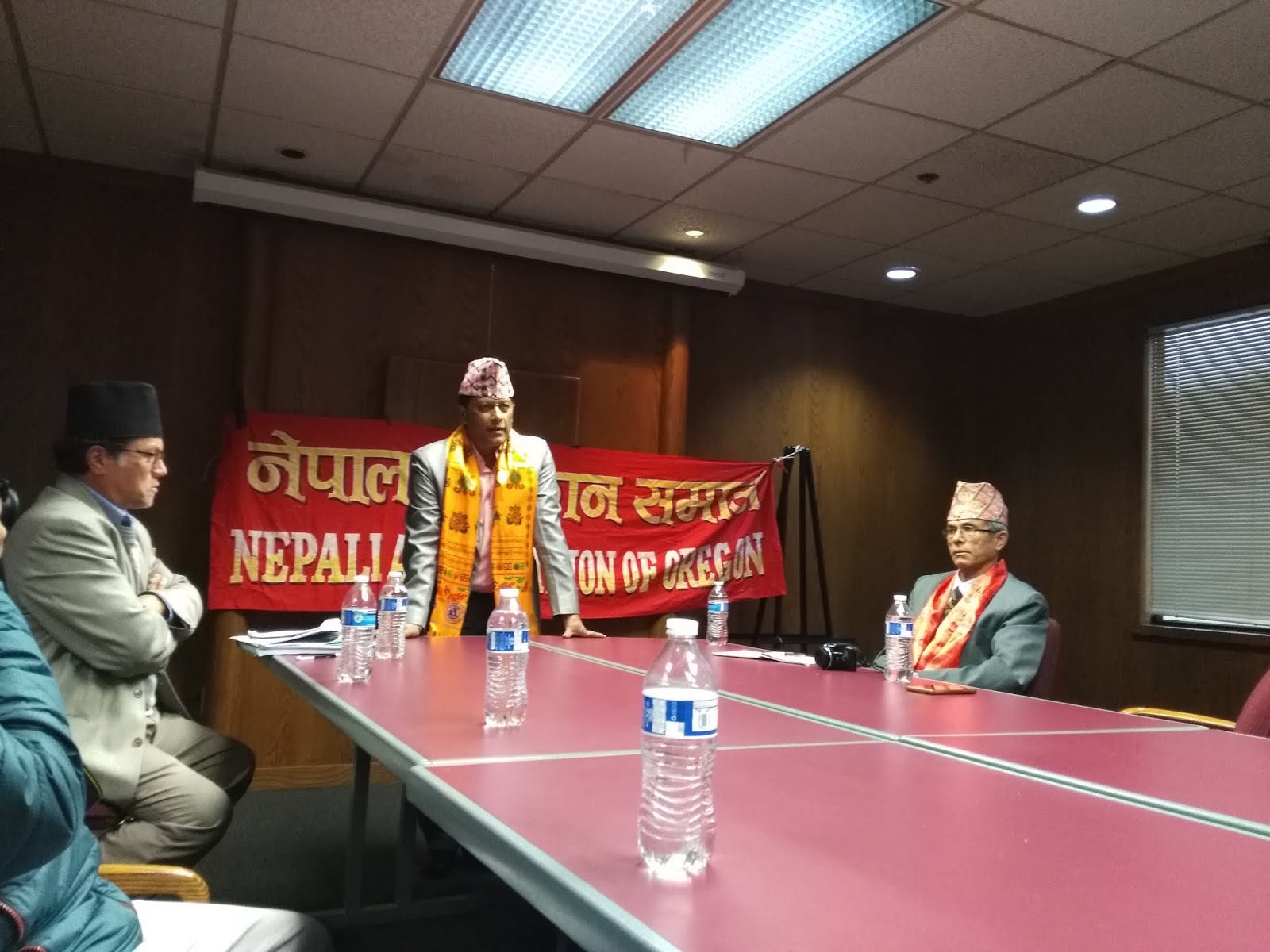
Bharat Banskota, president of Nepali Association of Oregon felicitated Radheshyam Lekali, president of INLS and Prof Dr Khagendra Prasad Luitel, INLS advisor by wrapping Khadas (traditional ceremonial scarves) on them.


It is to be noted that International Nepali Literary Society is organizing literary programs in Oregon, Washington, Texas, Colorado and California.

Speaking at the literary program, president of INLS Radheshyam Lekali expressed the view that his organization is committed to enhance and promote Nepali language and literature across the world.

 INLS chief Lekali said:"Literature has no boundary. Our Nepali literature acts as a bridge or platform that unites all the Nepalese people living across the world."

Role of literature for the community and society is very huge, he said adding that literature acts like a common school  which teaches people to become good and responsible citizens.


INLS is always ready to provide a literary platform for Nepali literary "surgeons," Lekali added.

Likewise, speaking on the occasion,  INLS advisor Prof Dr Khagendra Prasad Luitel expressed the view that literature is a mirror which reflects the social issues and problems. 

 Literature shows the right and correct path to life. That is why role of literature in the society is tremendous, Dr Luitel said.

 Dr Luitel further said that the Nepalese in America should be able to preserve the identity of being a "Nepali."


Asked him by Nepal Oregon News about the common practice of calling the Nepalese living abroad by "diaspora," Luitel said that "Aaprabashi" would be more appropriate. But the word "diaspora" has a broader meaning as well, he said.

Mohan Gurung, former president Seattle Nepal Society read a poem "Line Yehi Dine Yehi". Similarly, poems on different themes were recited by Anjali Bajracharya, Kusumabati Bajracharya, Naveena Shakya and Dillu Thapa, while a short story "Bano Bhat" was read by Daya Shakya.


The literary program which was presided over by NAO president Bharat Banskota was conducted by former NAO president Daya Shakya.The program was also attended by, among others, representatives of Nepali Association of Oregon, Nepaa Chhen, NRNA - USA - Oregon Chapter and Nepal Oregon News.


(Nepal Oregon News writer Rabin Man Shakya is a Nepali journalist in America)

Sunday, October 7, 2018

NRNs (from Nepal) Are Just Emigrants, Not Diaspora

Rabin Man Shakya
Portland, USA


Non-resident Nepalese (NRNs) living across the world are just emigrants, not diaspora, or not even a part of diaspora. Globalization and global migration after the end of Cold War in 1990s have resulted in creating many things. One of them: the NRNs.

The very practice of the people in the NRNA leadership positions to use the word "diaspora" for the NRNs all over the world is not only inappropriate and irrelevant but also misleading.

Why do some people use the irrelevant and inappropriate words to define certain communities and groups of people? Is it because they want to use trendy, big and difficult words to show they are smart and educated?

NRN leaders may have different motivations for using pompous words. They may want to sound more impressive. But NRNs are just emigrants, not diaspora.

In fact, diaspora is a Greek word "diaspeiro" which means "I scatter" or "I spread about". Shortly, it means dispersal.

Diaspora is defined as involuntary mass dispersions of a population from its indigenous territories. The reason for involuntary mass dispersions of a population could be famine, natural calamities, expulsions, extreme poverty, ethnic cleansing, escaping from brutal and repressive regimes

Historical experience shows that diaspora are those people who are forced to move to other countries. Are NRNs diaspora or a part of diaspora? The answer will be: No. As a matter of fact, NRN people were never forced to leave the country.

NRNs are just the emigrants and all emigrants are not diasporas. In the age of globalization, people who move to other countries for business, jobs and studies are not diaspora. They are just emigrants.

And, then the question arises: Are there any genuine Nepali diaspora anywhere in the world? Nepalese who lived in Bhutan, Manipur, Assam, Burma, etc are definitely real diaspora.

Sunday, September 16, 2018

Sawa Lakh Deep Prajjwalan (Nepali Style) at Nritya Mandala Mahavihara in Portland, USA

Dr Rabin Man Shakya


Portland, Sept 16 (Nepal Oregon News): Living in the United States and trying to keep the culture and traditions of Nepal alive is a formidable challenge which is being faced by the Nepalese in America.

Nritya Mandala Mahavihara, Nepali Association of Oregon (NAO), Nepa Chhen, NRNA - USA - Oregon chapter, Nepal Oregon News are some of the institutions in Portland, Oregon, USA which are committed to preserve and enhance the culture and traditions of Nepal.

Promoting, preserving and protecting our traditional and cultural values are, actually, not an easy work. It is very hard and arduous task, but Nepalese Portlanders are giving it a shot.

Sawa Lakh Deep Prajjwalan - an act of lighting of one hundred twenty five thousand (125,000) cotton wicks soaked in sesame oil, five baked clay dishes and burnt - was performed here at Nritya Mandala Mahavihara in Portland, USA on Saturday,  Sept 15, 2018.


On the occasion, an Itah Kayegu practice was also organized at Portland's Newah Buddhist temple in which about 20 Newah women from Oregon participated.

Itah Kayegu is a manual and handmade process in which a Newah woman using her hands and fingers stretches up the cotton by, kind of, spinning, dragging and intertwining and finally making an Itah which is used for sacred burning.


Speaking on the occasion, Daya Shakya, vice president of World Newah Organization said that Ita Kayegu and  Sawa Lakh Deep Prajjwalan are a unique preliminary practice from the ancient households of the Nepalese people and hence have a tremendous traditional importance.


Today more than ever, depression is a big problem for the people across the world. Addressing the gathering at the temple, Prajwal Vajracharya of the Mahavihara said that scientific importance of Ita Kayegu lies in the fact that it helps to do away with depression as veining mechanism is affected  in a healthy way by the movements of fingers during the Itah Kayegu process.

Anastasia Roderick of the Mahavihara underlined the need to preserve this kind of practice.

Sawa Lakh Deep Prajjwalan is a fine ritual to benefit any wish of a man or a woman. Live burning ritual of Sawa Lakh Itah Chyakegu was initiated by Padma Laxmi Karanjit and her family at the temple. The Prajjwalan ceremony was ritualized by Prajwal Guruju.

The ceremony was followed by tea, snacks, wine and potluck dinner.


(Rabin Man Shakya is a Nepali journalist in America)

Saturday, September 8, 2018

Panjaran (Panchadan), a festival of Newar Buddhism, Celebrated at Nritya Mandala Mahavihara, Portland, USA

Naamsangiti, Das Paramita and Daan Gatha Chanted by Newar Buddhist Portlanders


Dr Rabin Man Shakya


Portland, Sept 8 (Nepal Oregon News): One of the important festivals of the Newah Buddhists "Panjaran"  was celebrated here at Nritya Mandala Mahavihara in Portland, USA.

Panjaran is also Panchadan which means giving away different kinds of alms, such as, grains and fruits like rice, paddy,  salt, peas, bananas, radish etc to people from Vajracharya and Shakya communities.

On the occasion, various Buddhist Tutas like Mahayana Sutra, Naam Sangiti, Bandeshree, Dasparamita,  Daan Gatha and Siddhi Muni were recited by  chief pujari  Guruju Prajwal Ratna Vajracharya, linguist Daya Ratna Shakya,  Guruju Pradeep Vajracharya and  journalist Dr Rabin Man Shakya inside the Buddhist temple at the Mahavihara.


After the reciting of Holy Tutas, as per the Buddhist tradition, different kinds of alms, such as, rice, peas, bananas, apples and money were given away by Mahavihara's Guruju (preist) Prajwal Ratna Vajracharya, Jaya Shakya, Dina Shakya and Anastasia Roderick to Portland"s local Newah Buddhists.

Raw rice was offered to the Panjaran participants from the Gulpa, just like in Nepal, in front of the large statue of Lord Buddha.

At the end of the Panchadan program at the Nritya Mandala Mahavihara, Portland's Panjaran participants were offered the Khir lunch in the " Kayan Yagu Dema" (traditional Newah plate made of brass).

Panjaran ceremony in Portland was reminiscent of Panjaran activities in Kathmandu.

Nritya Mandala Mahavihara has moved to centerstage in Nepalese cultural scenario in Oregon by organizing a lot of programs and ceremonies related to festivals and culture of Nepal.

Prajwal Guruju of Nritya Mandala Mahavihara in Portland said that Portland's Buddhist Mahavihara also keeps the tradition alive by carrying on Tuta Bwonegu for a month until the end of the month of Gunla.

Tuta Bwonegu is a month-long practice of reciting Bajrayana Buddhist Tutas among the Newah Buddhists of the Kathmandu Valley during the month of Gunla (August-September).

There is no doubt that Nritya Mandala Mahavihara has been doing praiseworthy and commendable job by trying to keep the tradition and culture of Nepal alive in the USA.

It is to be noted that the establishment of Nritya Mandala Mahavihara in Portland in 2009 AD has paved the way for local Nepalese Portlanders to carry on with lots of ritual and cultural ceremonies like the way it is done in the Kathmandu valley.

The forthcoming "Sawa Lakh Dipa Prajwolan" (the lighting of one hundred twenty five thousand oily wicks) to be organized at the Mahavihara on Saturday, Sept 15, 2018 is a testimony to it.


(Rabin Man Shakya, who is a Newar journalist in America, is a Sangha Member of Nritya Mandala Mahavihara and also a Life Member of World Newah Organization.)

In Vajrayana Buddhism, a Dakini is the Ultimate Personification of Fierce Feminine Wisdom: Prajwal Vajracharya

Four-week Teaching Course on 'Embodiment of the Dakini Praise' Wraps Up Rabin Man Shakya Portland, Sept 20 (Nepal Oregon News): A fo...