Saturday, April 16, 2016

Shrestha, Other Nepalese Felicitated in Portland, America

Dr Rabin Man Shakya


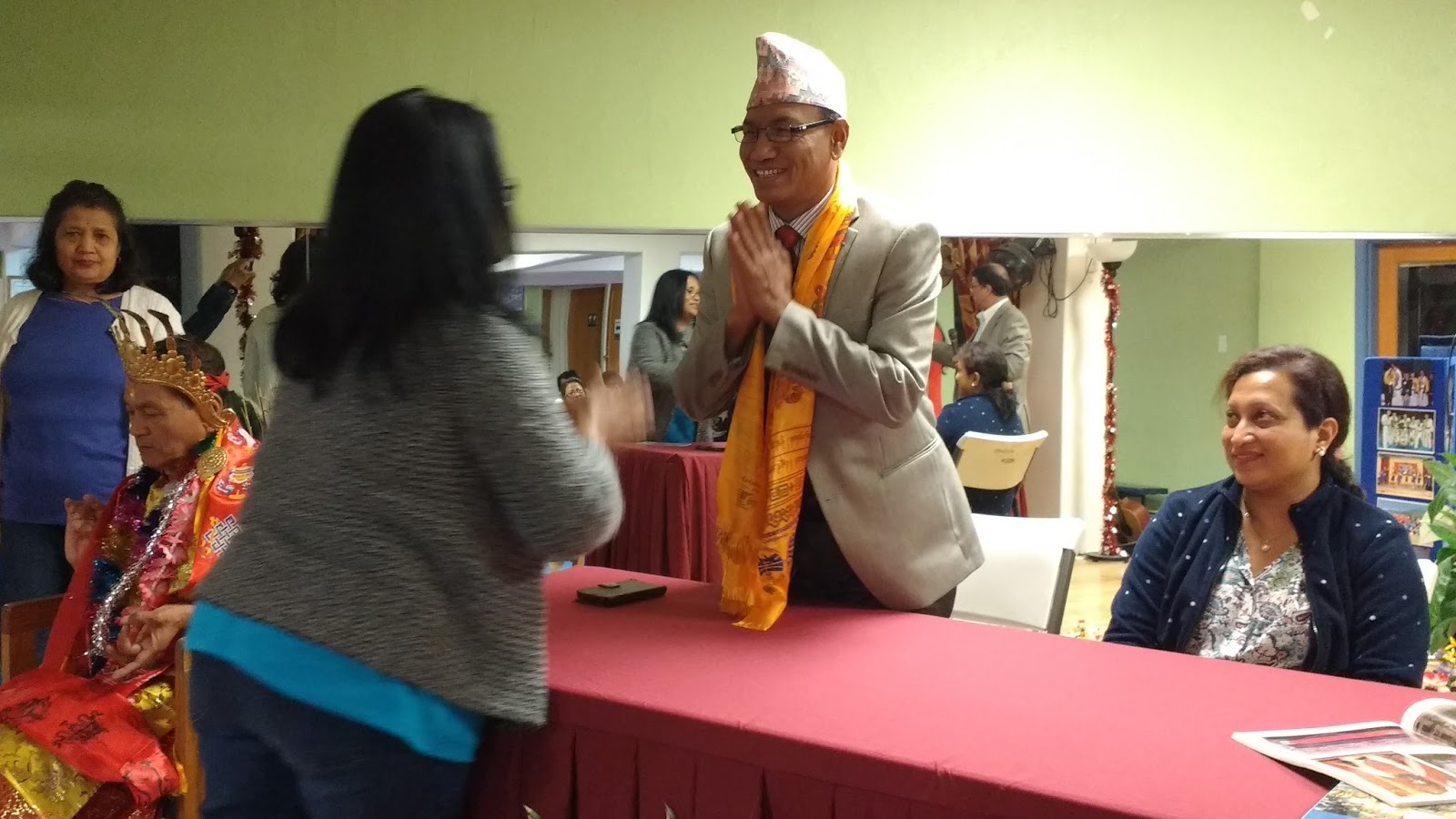
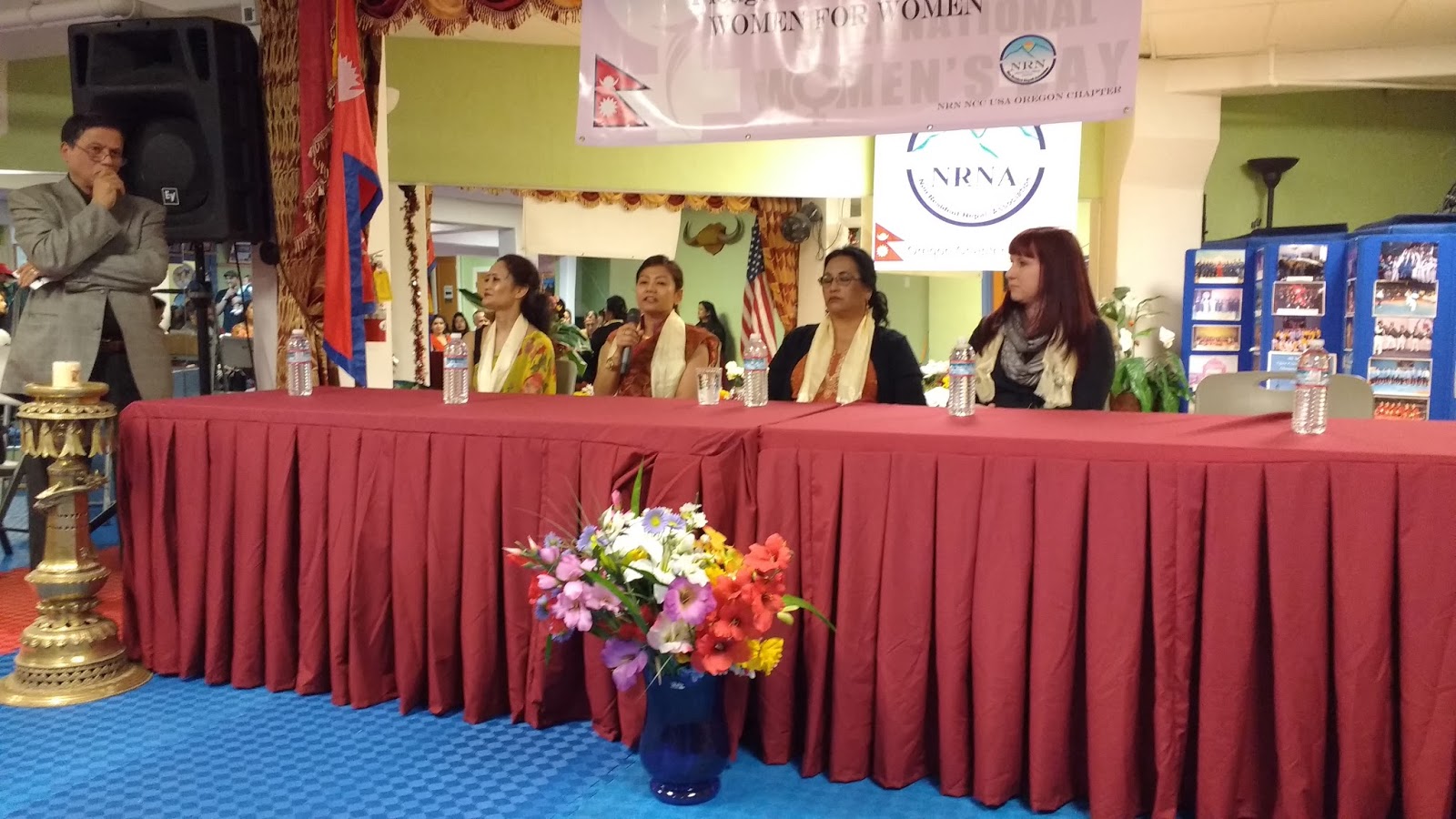
Portland, April 16 (Nepal Oregon News): A program was held on Friday April 15, 2016 at Nekusing Memorial Theater (US West Coast Taekwondo Hollywood) in Portland, Oregon by the Nepalese community to felicitate Rajendra Shrestha, former minister and leader of the Federal Socialist Forum, Rasmila Prajapati, a journalist with the Kantipur FM radio and Dharma Ratna Shakya, a Buddhist acting as Dipankar Buddha.

It is to be noted that Shrestha, Prajapati and Shakya are on a visit to the United States to take part at World Newah Organization's (WNO)  international convention held in Baltimore (March 25-27, 2016).

Noted taekwondo instructor and president of Non-resident Nepalese Association USA, Oregon Chapter Diwakar Maharjan, general secretary of IOFTC Karen Blackledge, President of Nepalese Association of Oregon Ganga Sharma and general secretary of Nepa Chhen Pramod Karanjit felicitated the guests by wrapping Khata on them.

In a sweeping address that took on sharp political tones, Rajendra Shrestha said: "The mainstream political parties and their political leaders have not been able to rise above their petty partisan and personal interests, while the Federal Socialist Forum always stands for the nation and the people."

Shrestha went on to say:"Today's constitution of Nepal is not intended for the resolution of the problems, but it intends to aggravate problems of the people."

Speaking to a gathering of about 70 Nepalese Portlanders, Shrestha said the Forum's movement is for identity and federalism issues. He said:"The identity issue which was recognized by the Interim Constitution of Nepal was tricked away by the new Constitution of Nepal."

The issue of ethnic provinces has sparked protests and violence across Nepal in the past. This is a very sensitive issue and the gravity of situation must be tackled by the responsible political parties, Shrestha went on saying.

Replying to a question of Nepal Oregon News on factionalism within the communist parties of Nepal, Shrestha said though the country's situation is different today, and  communist parties are confronted with dealing with entirely new problems and issues of contemporary times. The groupings and factionalism with its root in the past bounce back with vengeance time and again,  Shrestha added.

Speaking on the occasion, Rasmila Prajapati, who is also the general secretary of Nepal chapter of the World Newah Organization, underlined the need for gender parity in Nepal.

Prajapati expressed happiness over the fact that today President of Nepal, Speaker of the Parliament and Chief Justice of Nepal are all Nepali women. Women's movement is making tremendous strides in Nepal, although a lot is yet to be done in this direction, she said.

The fact that citizenship is not granted to a child on the basis of a mother's side in Nepal  is outrageous, Prajapati said.

The program which was conducted by World Newah Organization's vice president Daya Shakya was followed by a pot-luck dinner and songs in Nepal Bhasa and Nepali. From among a number of amateur  singers at the program, it was former minister Shrestha who stole the show by singing  "Ma Patthar Ko Devata Hoina" and "Guli Balan Chhangu Khwaa Sa Yaye Mazil."


(Rabin Man Shakya is a Nepali journalist in USA)

Friday, April 15, 2016

Lull Before the Storm

By Dr. Rabin Man Shakya

There were palace intrigues and political maneuverings even during the rule of Lichhavis and Malla Kings of Nepal. But as far as I know from the history of Nepal, ordinary people were not cheated by the Lichhavis and Malla rulers.
Cheating and humiliating the people especially the ethnic communities of Nepal started right after the advent of Shah dynasty in 1768 AD.
The process of cheating the people by the ruling elites of Nepal during different periods of history went on unabated. Even today, this process is going on. Living conditions are deplorable in Nepal. People are facing multitude of problems after the earthquake and Indian economic blockade. The nation is plagued by lack of law and order, insecurity, joblessness. Corruption and misuse of power are rampant in Nepal. There is not enough water to drink and load-shedding is a perennial problem.
Given the greed for power and the government's utter negligence of the grievances of the people, it looks like the Nepalese people are destined to be deluded and tricked by the rulers for ever.
The tendency of cheating the people by the ruling elites that began in 1768 right after the Shah dynasty's advent is still continuing today too albeit in a subtle and unseen manner.
The recent protests and agitation of the ethnic people are only the justifiable outcomes of the continuous cheating and suppression of the people by the ruling elites that started in 1768. It looks like the protests and agitation of the ethnic communities have come out quite effectively recently. The decision of the Madheshi parties to ease the agitation is just a lull before the storm. Ethnic conflict is still looming large anytime soon, which is justifiable given the uni-cultural nation and one-language concept we have been living in for centuries.
The government and the mainstream political parties should come to a consensus to justly address the grievances of the ethnic people, before it again bursts out.

Wednesday, April 6, 2016

Pahan Chare: One of the Biggest Cultural Festivals of Newah People

Dr Rabin Man Shakya
Former Associate Editor
The Rising Nepal


Portland, (Nepal Oregon News): Pahan Charhe is one of the biggest cultural festivals of the Newah people in Nepal. Nowadays, Pahan Charhe is celebrated not only by the Newah people living in Nepal but by the Newah people who are scattered  across the world too.

Actually, Pahan means guest in Nepal Bhasa and Charhe stands for Chaturdarshi which in turn means the 'fourteenth day of the lunar fortnight. So, in a few words, it means the festival of and for guests. By the way, this year's Pahan Charhe is on April 5, 2019  which is also the day of Pisach Chaturdarshi.

It is to be noted that in Portland, Oregon, Mha Puja - Nepal Sambat and Mohani Nakha are the Newah festivals that are celebrated in community level very enthusiastically. Yes, Pahan Charhe is celebrated in community level too by Newah people in Japan and Britain and also in big US cities like New York and DC. Nevertheless, celebration of Pahan Charhe is confined to family members and friends here in Portland. Well, majority of the Newah people in Portland do celebrate Pahan Charhe in their own way. Last year, my spouse organized a 'Bhoe' (feast) in our family in Portland. This years's Pahan Charhe, we have to live with 'Gwarcha' which means thick soup with different beans and Newar Momo dumplings.

Looking back nostalgically to my childhood days at Naghal Tole, Kathmandu, I remember how we eagerly and fervently waited for Pahan Charhe.

There used to be 'Luku Mahadyo' at our chowk at Naghal Tole. Luku Mahadyo which means 'hidden Mahadev' was enshrined in the ground of our chowk. We, the children of the chowk neighborhood, used to go here and there in the periphery to gather the Lubu ( green rape blooms) and Wobu (radish blooms) to decorate and beautify the Luku Mahadyo.

In the evening, the ladies from each households used to perform worship to Luku Mahadyo by offering feast which included Baji (beaten rice), Dayekaula (meat curry),  Chhoyela, Bhuti, Lain Achar, Laba Tarakari, Tukancha, Pukau etc. Taking a trip down lane memory, we used to enjoy the offerings made to Luku Mahadyo. Boy, that was a lot of fun.

The traditional 'bhoe' (feast) is served to the family members in the evening according to traditions. on the day of Pahan Charhe.

Today even though Pahan Charhe is still celebrated by the Newah people in Nepal and across the world, the tradition of decorating Luku Mahadyo  with rape blooms and radish blooms on the day of Pahan Charhe is slowly vanishing. Thanks to globalization and global media culture, many important components of traditional values of the Newah people are in danger of extinction.

If we go by the assumption that festivals are important component of the culture, then sincere endeavours and appropriate government cultural policy should be enforced to preserve and keep up traditions and festivals.

No doubt, Nepal is a country of festivals. There are so many festivals of different ethnic communities of Nepal. The culture of any country is reflected in the way of living and lifestyle of people. There are many castes and ethnic groups in Nepal. Each ethnic community  including the Newah people have their own customs, culture and traditions. Living in the same nation, they strive to preserve and safeguard their own culture.

In economic terms, Nepal may be a poverty-stricken country, but in the front of arts and culture, there are reasons for Nepal to be proud of her cultural heritage, ancient arts and architecture.

There is no doubt that celebration of Pahan Charhe festival is one of the best traditions of the Newah people.


**Dr Rabin Man Shakya,  a Portland, USA  based Nepali journalist, is former assistant editor at the RSS, former associate editor at The Rising Nepal and former lecturer of journalism at the Peoples Campus.

Wednesday, March 30, 2016

World Newah Organization's International Convention Wraps Up with Baltimore Declaration

Dr Rabin Man Shakya


Portland, March 30 (Nepal Oregon News): When about 350 prominent Newah personalities from 10 different countries of the world turned out at the Second World Newah Convention in Baltimore, USA from March 25-27, 2016, it is a testimony of the fact that global Newah movement is steadily gaining momentum.


The World Newah Organization (WNO) convention was participated by different personalities of the US from 10 different states while other prominent participants included from Nepal, India, Britain,  the Netherlands, Canada, Kazakhstan, Portugal and Switzerland etc.


Nepal has sent a 30-member  strong team to take part at the WNO convention. The 30 member Newah delegation from Nepal included Rajaram Shrestha, spokesperson of Rastriya Prajatantra Party and Pushkar Mathema, chairman of the Nepal chapter of the WNO.


Meanwhile, the three-day international convention of the  WNO - which was jointly inaugurated by Nepalese Ambassador to the US Dr Arjun Kumar Karki and indigenous leader Malla K. Sundar at Hotel Sheraton, Baltimore - wrapped up recently with the adoption of seven-point Baltimore Declaration.


According to Article 1, Sub-article 3 of the Section 169 and sub-section 28 of the Geneva Convention of the United Nations Organization, the world body has called upon all the governments of the world for the constitutional provisions for the indigenous communities. The new democratic and republican constitution of Nepal has not incorporated anything about the indigenous communities of Nepal.  The World Newah Organization has brought out the Baltimore Declaration consisting of seven important points, including exerting pressure on Nepal government to enforce the provisions of indigenous communities as per the Geneva Convention.


On the occasion, Krishna Chakhun from Kazakhstan read out the seven-point Baltimore Declaration on behalf of the organizers.


Hopefully, this jamboree of the global Newahs in Baltimore will be a big milestone in the chronicles of global Newah movement.


It is to be noted that my friends Daya Shakya and Diwakar Maharjan have participated at the international Newah conference on behalf of Portland, Oregon while my friend (still from Minsk, the USSR days) Krishna Chakhun has taken part from Kazakhstan and my colleague from the Gorkhapatra Corporation Pushkar Mathema has joined in at the global Newah meeting from Nepal.


Meanwhile, the global Newah conference has declared the new executive committee of the WNO according to which Season Shrestha from Baltimore, USA is the new president, Daya Shakya from Oregon, USA is first vice president and Dr Narayan Rajbhandari from North Carolina, USA and Swayambhu Dhar Tuladhar are the vice presidents. Likewise, Subhash Prajapati from Seattle is the general secretary and Krishna Chakhun from Kazakhstan and Rajani Shrestha from San Francisco are public relation officers.


The WNO which has moved to centerstage in global Nepal Bhasa movement should make uniting Newars across the globe, to preserve and promote Nepal Bhasa, Newah culture and identity the centerpiece  of its agenda. WNO's presence is already strong and effective in the global Newah movement. The top priority of the WNO should be to bring in all the Newars and all the Newah organizations into one big umbrella organization irrespective of political creed and beliefs. As of now, there are more than 30 Newah organizations of the Newah communities in about 20 countries of the world.


WNO is an international platform of the Newah people scattered across the world to champion the cause of strengthening and consolidating Newah indigenous movement and Newah culture and identity.  That's fine, but the WNO should not be preoccupied with its indigenous agenda alone because it may create controversy in the scenario of Newah people's broader political spectrum. The WNO should rise above the petty political interests and should get down to the comprehensive process of unifying the Newah people of every hue. With its first convention in London and second one in Baltimore, the WNO has become an important stakeholder and partner - for Nepal Bhasa's development, for enhancing Newah people's rich culture and traditions - in international level.


Nevertheless, with Malla K Sundar, an indigenous leader inaugurating the WNO convention in Baltimore and Rajendra Shrestha, co-chairman of Federal Socialist Forum - Nepal delivering a keynote speech on the occasion, some sections of the Newah movement have accused the WNO -- of becoming a political wing of the Janjati parties of Nepal -- in the social media sites.


There is no doubt that the WNO must work as an international Newah platform that takes care of all the Newah people regardless of political inclination. The WNO should not be used as a tool for "grand design" by political parties and should not be contracted by viruses of political maneuvers and bickering. The WNO should leave no stone unturned  to prove this to the entire Newah population across the world.


The challenges facing the World Newah Organization are indeed formidable since the global organization has to work for the broader interests of Newars living in Nepal as well as of the Newars living across the world.

*Also, please read a relevant article entitled "World Newah Organization (WNO)  and the issue of Newah unity" published in the Nepal Oregon News on Dec 25, 2024.

Sunday, March 20, 2016

Non-resident Nepalese Association (NRNA) USA Oregon Chapter Celebrates International Women's Day in Portland, America

There Should Not Be Any Gender Inequality: Blackledge

Dr Rabin Man Shakya


Portland, March 20 (Nepal Oregon News): Non-resident Nepalese Association, National Coordination Committee, USA Oregon chapter organized a program emphasizing "Pledge for Gender Parity" to mark the International Women's Day (IWD) on Saturday March 19, 2016 at Nekusing Memorial Theater,  (US West Coast Taekwondo Hollywood) Portland.


Group Shot


Naveena Shakya reading a poem on Nepal-America  friendship.

A one-minute silence was observed at the beginning of the program in memory of the late Helen Ward Mali who passed away last year in Portland due to breast cancer complications.

On the occasion, Anjali Bajracharya and Kusumabati Bajracharya recited poems on women's issues while Naveena Shakya, former food-research officer at the Department of Food Technology and Quality Control of Nepal (DFTQC) presented a poem on Nepal-America friendship.

Addressing the gathering, IOFTC general secretary Karen Blackledge said that women can do whatever the men do, therefore  there should not be any gender inequality.

Angela Mckenzie-Tucker, president of Hollywood Booster, speaking on the occasion underlined the need for creating equal opportunities for women.


Sunil Rajkarnikar speaking about women empowerment. 


President of Nepalese Association of Oregon Ganga Sharma expressed the view that women should just not be treated as pretty faces, not just as objects as today millions of women are professionals in different fields.
The Speakers for the Event 
Master Sita Rai shed light on her experiences, on vicissitudes before becoming a taekwondo professional.

General secretary of NRNA-NCC-USA Oregon chapter Sunil Rajkarnikar shed light on the importance of women empowerment at the program which was attended by about 150 Nepalese people living in Portland and its periphery. 

Among them were representatives from Nepali Association of Oregon (NAO), NRNA-NCC-USA Oregon chapter, Nepaa Chhen and Nepal Oregon News.The program was conducted by vice president of World Newah Organization and NRNA Oregon chapter vice president Daya Shakya.


The Audience

It is to be noted that on Feb 28, 1909, the Socialist Party of America celebrated  the first International Women's Day by honoring female garment workers who were protesting against poor working conditions.

Since the first IWD was marked, there has been a significant improvement in the lives of women across the world in terms of gender equality, education, health, awareness and women empowerment.

Meanwhile, earlier on the same day, a workshop on "Inspired by Laser Light: Career in Science" was also organized by NRN-NCC-USA Oregon chapter at Nekusing Memorial Theater, Portland.

Dr Manoj Kansakar dwelt on what a laser is and its use in applications ranging from household electronics to solving world energy problems and exploration of many scientific endeavors.
About 50 Nepalese community members benefitted from the workshop.


Smiles: Naveena Shakya, Padma Laxmi Karanjit and Jaya Shakya.


(Rabin Man Shakya is one of the few Nepalese journalists in America)

Wednesday, February 10, 2016

Gorkhapatra's Stop Press and News Story on Sushil Koirala's Demise

Rabin Man Shakya
Former Associate Editor, The Rising Nepal

Nepal's former Prime Minister Sushil Koirala  passed away 12:50 AM Tuesday in Kathmandu due to complications from pneumonia and respiratory failure. He was 78. May his soul rest in peace.

Meanwhile, by publishing the banner headline news on the demise of Koirala, former PM of Nepal and president of the Nepali Congress (GOP of Nepal), the Gorkhapatra national daily has again reminded me of the word "Stop press", something even the world  famous  newspapers like The New York Times and The Wall Street Journal had abandoned long time ago.

So it turns out that it was only the Gorkhapatra which was able to carry out the news story on Tuesday morning, the day Koirala passed away. All other broadsheet dailies are going to publish the news story on Koirala's death on Wednesday.

It is to be noted that Koirala was a key figure in the adoption of Nepal's new constitution last September, and also was the president of Nepal's largest political party. He was one of the very few honest and uncorrupt  politicians of Nepal.

Speaking of the 'stop press',  the newspapers like The New York Times and The Wall Street Journal had skipped many important national and international news stories like San Bernardino shooting and Charlie Hebdo massacre to be published not in the following morning but a day after, which made the news stories already too stale.

I remember when the Communist Prime Minister Man Mohan Adhikari passed away on April 26, 1999, the Gorkhapatra and The Rising Nepal had practiced the 'stop press' too. Adhikari died on April 26, 1999 at night at about 2 AM. At that time, I used to work at the night desk at The Rising Nepal. As a matter of fact, even at that time, the Gorkhapatra and The Rising Nepal were the only two broadsheet daily newspapers to break the news about the death of the first democratically-elected Communist Prime Minister of Nepal.

Fifteen years ago, the stop press used to have more relevance than today.That is because digital journalism and social media sites have been frequently breaking the important news lately. So when we at The Rising Nepal and the Gorkhapatra, kind of,  did the stop press for the news story about passing away of Man Mohan Adhikari, it had more relevance than in today's age of social media.

So what is the 'stop press' actually? In short, it means an important news item inserted into a newspaper after the printing has been started. It may also mean the space  regularly allocated for more important news. It is true even 20 or 25 years ago, stop press did not take place very often in the newspapers.

Today more than ever, with the digital journalism and social media sites gaining momentum, use of stop press is very rare in practical journalism. So what was the relevance of the stop press in the newspapers in the past? Why did newspapers sometimes use stop press?

Senior journalists at The Rising Nepal used to tell us there were cases during the period of Panchayat system the printing press literally had to be stopped or delayed and much of the already printed copies had to be discarded causing loss to the Gorkhapatra Corporation in order to give space for royalty news or to correct error on royalty news.

Friday, February 5, 2016

Memorable Moments in Santa Clara


Rabin Man Shakya
(A Nepali journalist in USA)


Portland, Feb 5, (Nepal Oregon News): In December 2015 right after the Christmas holidays, I along with my spouse Naveena Shakya were in Santa Clara. We stayed with Dr Mahendra Man Shakya, a physicist  and his wife Pratibha, my sister-in-law.  Our visit to Santa Clara was very important to us because we could meet Dr Mahendra and Pratibha after 14 years. Oh boy, that's a long time.

Likewise,  Naveena was overwhelmed to meet her childhood friend Dr Roshani Shakya,  her husband Dr Pradip and her mom at Woodland, Sacramento. So, our nine-day journey to California took us not only to Santa Clara but to San Francisco, Sacramento, Santa Cruz, Stanford University etc. Our  walk-through at the capitol building in Sacramento was also very memorable.


Naveena Shakya and Pratibha Shakya at Santa Cruz.


Alcatraz
Dr Mahendra Man Shakya and Dr Rabin Man Shakya at the Capitol in Sacramento, California.


In Sacramento
Dr Pradip Shrestha, Dr Roshani Shakya, Roshani's mom and Naveena Shakya.

Well, it was Dr Mahendra who took us to many interesting places in Santa Clara including the Levi's Stadium, the venue of Super Bowl 50. He generously took us to SF, Sacramento, Santa Cruz, Stanford University, Twin Peaks, Shoreline and so on.


Rabin Man Shakya, Naveena Shakya, Pratibha Shakya and Mahendra Man Shakya at Twin Peak.


An evening at Santana Row, Santa Clara: Mahendra Man Shakya, Rabin Man Shakya and Naveena Shakya.


Compared to my extensive travels and trips to the cities of the former USSR and Europe, I have not travelled that much across the United States. Never been to big cities like New York and Boston.  Well, I have been living in Portland, Oregon for over a decade and so far have been able to see  Chicago, Seattle, Dallas, San Antonio, Austin, Eugene etc and this time, to see Santa  Clara, SF, Santa Cruz, Sacramento etc.


Mahendra Man Shakya and Pratibha Shakya.


Naveena Shakya and Pratibha Shakya.


Santa Clara, no doubt, is a small  city, but it is a fast growing city. One of the distinct things  I noticed in Santa Clara is the preponderance of Indians who according to 2010 US census are 43,889 (37.7 %) of Asians living in Santa Clara. In Santa Clara, you see Indians wherever you go. Also, you see so many Indian restaurants, Indian sweetmeat shops and Indian groceries. And when you go inside these stores, you see they are crowded with the Indians and you feel like you are somewhere  in New Delhi.

Well,  I am pretty  much impressed by my visit to Santa Clara which is located in the center of Silicon valley  and which is home to the headquarters of several high tech juggernauts like Intel and Google. Visiting Santa Clara in the evening especially along the El Camino street and Santana Row reminded me of the bright and sparkling, illuminated streets of European cities.


Rabin Man Shakya on a Google bicycle.

The unforgettable  moments of our journey was  that of a visit to  Golden Gate bridge  of San Francisco. I have seen the Alcatraz prison building in several movies and documentaries but it was the first time I saw it. Alcatraz  today is a public museum which is one of San Francisco's major tourist attractions.


Mahendra Man Shakya, Rabin Man Shakya, Naveena Shakya and Pratibha Shakya at the Golden Bridge in San Fransisco.


Anyone going to San Francisco should not miss to visit Fisherman's Wharf  which is also a popular tourist attraction in San Francisco. The Fisherman's Wharf is famous  for being the location of Pier 39, the Canary Shopping Center, Ghirardeli  Square, Wax Museum, Ripley's Believe It or Not Museum etc.


We had an opportunity to be at Santa Cruz Beach Boardwalk which is an oceanfront amusement park in Santa Cruz. I must admit that our  visit to Santa Clara and other  cities widened my perception about California.

Shira Daan and Sankalpa Puja in Newar Buddhism

Portland, Nov 25 (Nepal Oregon News): In memory of her deceased mother, Naveena Shakya, a Sangha member of the Nritya Mandala Mahavihara off...