Wednesday, March 30, 2016

World Newah Organization's International Convention Wraps Up with Baltimore Declaration

Dr Rabin Man Shakya


Portland, March 30 (Nepal Oregon News): When about 350 prominent Newah personalities from 10 different countries of the world turned out at the Second World Newah Convention in Baltimore, USA from March 25-27, 2016, it is a testimony of the fact that global Newah movement is steadily gaining momentum.


The World Newah Organization (WNO) convention was participated by different personalities of the US from 10 different states while other prominent participants included from Nepal, India, Britain,  the Netherlands, Canada, Kazakhstan, Portugal and Switzerland etc.


Nepal has sent a 30-member  strong team to take part at the WNO convention. The 30 member Newah delegation from Nepal included Rajaram Shrestha, spokesperson of Rastriya Prajatantra Party and Pushkar Mathema, chairman of the Nepal chapter of the WNO.


Meanwhile, the three-day international convention of the  WNO - which was jointly inaugurated by Nepalese Ambassador to the US Dr Arjun Kumar Karki and indigenous leader Malla K. Sundar at Hotel Sheraton, Baltimore - wrapped up recently with the adoption of seven-point Baltimore Declaration.


According to Article 1, Sub-article 3 of the Section 169 and sub-section 28 of the Geneva Convention of the United Nations Organization, the world body has called upon all the governments of the world for the constitutional provisions for the indigenous communities. The new democratic and republican constitution of Nepal has not incorporated anything about the indigenous communities of Nepal.  The World Newah Organization has brought out the Baltimore Declaration consisting of seven important points, including exerting pressure on Nepal government to enforce the provisions of indigenous communities as per the Geneva Convention.


On the occasion, Krishna Chakhun from Kazakhstan read out the seven-point Baltimore Declaration on behalf of the organizers.


Hopefully, this jamboree of the global Newahs in Baltimore will be a big milestone in the chronicles of global Newah movement.


It is to be noted that my friends Daya Shakya and Diwakar Maharjan have participated at the international Newah conference on behalf of Portland, Oregon while my friend (still from Minsk, the USSR days) Krishna Chakhun has taken part from Kazakhstan and my colleague from the Gorkhapatra Corporation Pushkar Mathema has joined in at the global Newah meeting from Nepal.


Meanwhile, the global Newah conference has declared the new executive committee of the WNO according to which Season Shrestha from Baltimore, USA is the new president, Daya Shakya from Oregon, USA is first vice president and Dr Narayan Rajbhandari from North Carolina, USA and Swayambhu Dhar Tuladhar are the vice presidents. Likewise, Subhash Prajapati from Seattle is the general secretary and Krishna Chakhun from Kazakhstan and Rajani Shrestha from San Francisco are public relation officers.


The WNO which has moved to centerstage in global Nepal Bhasa movement should make uniting Newars across the globe, to preserve and promote Nepal Bhasa, Newah culture and identity the centerpiece  of its agenda. WNO's presence is already strong and effective in the global Newah movement. The top priority of the WNO should be to bring in all the Newars and all the Newah organizations into one big umbrella organization irrespective of political creed and beliefs. As of now, there are more than 30 Newah organizations of the Newah communities in about 20 countries of the world.


WNO is an international platform of the Newah people scattered across the world to champion the cause of strengthening and consolidating Newah indigenous movement and Newah culture and identity.  That's fine, but the WNO should not be preoccupied with its indigenous agenda alone because it may create controversy in the scenario of Newah people's broader political spectrum. The WNO should rise above the petty political interests and should get down to the comprehensive process of unifying the Newah people of every hue. With its first convention in London and second one in Baltimore, the WNO has become an important stakeholder and partner - for Nepal Bhasa's development, for enhancing Newah people's rich culture and traditions - in international level.


Nevertheless, with Malla K Sundar, an indigenous leader inaugurating the WNO convention in Baltimore and Rajendra Shrestha, co-chairman of Federal Socialist Forum - Nepal delivering a keynote speech on the occasion, some sections of the Newah movement have accused the WNO -- of becoming a political wing of the Janjati parties of Nepal -- in the social media sites.


There is no doubt that the WNO must work as an international Newah platform that takes care of all the Newah people regardless of political inclination. The WNO should not be used as a tool for "grand design" by political parties and should not be contracted by viruses of political maneuvers and bickering. The WNO should leave no stone unturned  to prove this to the entire Newah population across the world.


The challenges facing the World Newah Organization are indeed formidable since the global organization has to work for the broader interests of Newars living in Nepal as well as of the Newars living across the world.

*Also, please read a relevant article entitled "World Newah Organization (WNO)  and the issue of Newah unity" published in the Nepal Oregon News on Dec 25, 2024.

Sunday, March 20, 2016

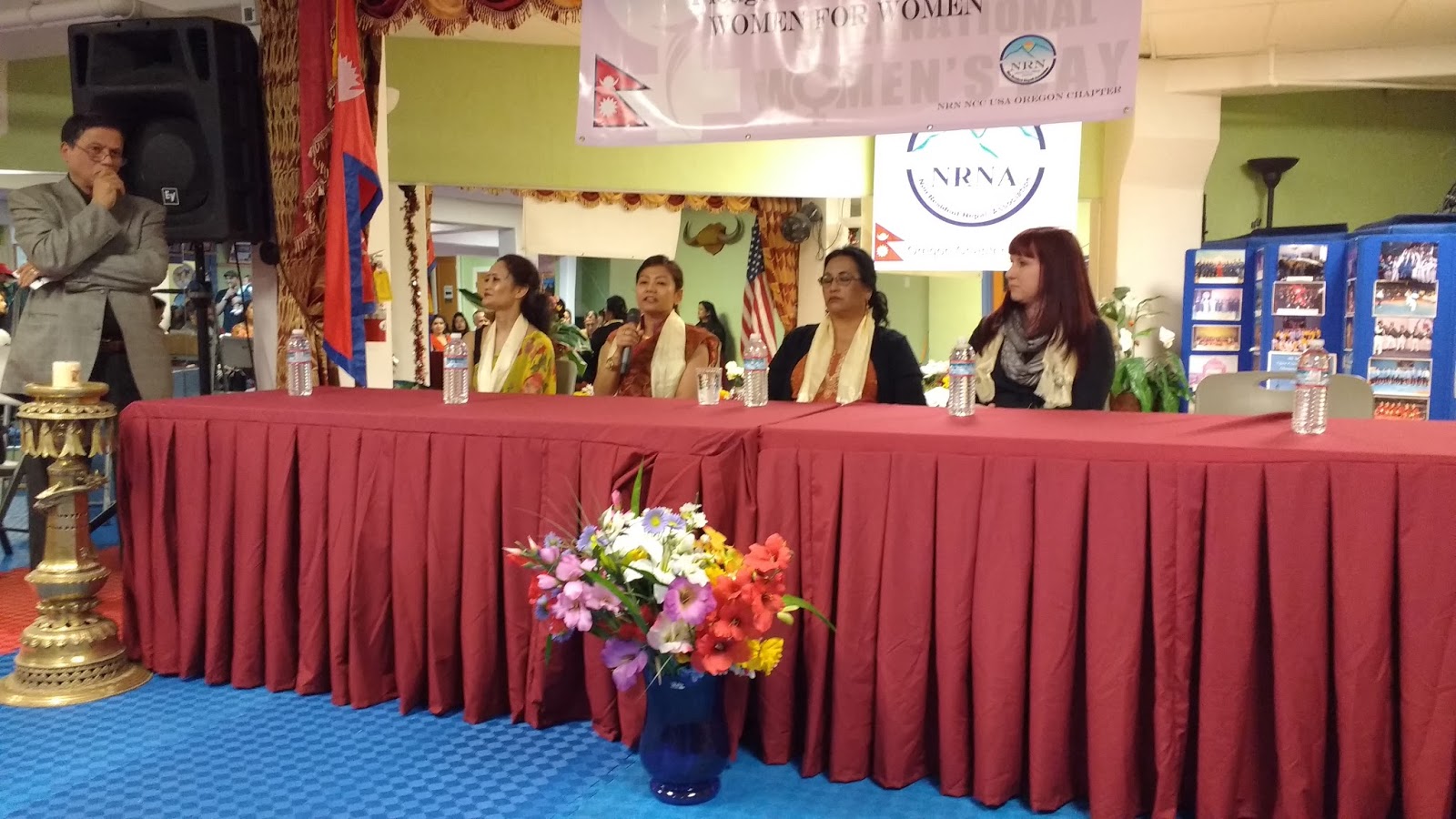
Non-resident Nepalese Association (NRNA) USA Oregon Chapter Celebrates International Women's Day in Portland, America

There Should Not Be Any Gender Inequality: Blackledge

Dr Rabin Man Shakya


Portland, March 20 (Nepal Oregon News): Non-resident Nepalese Association, National Coordination Committee, USA Oregon chapter organized a program emphasizing "Pledge for Gender Parity" to mark the International Women's Day (IWD) on Saturday March 19, 2016 at Nekusing Memorial Theater,  (US West Coast Taekwondo Hollywood) Portland.


Group Shot


Naveena Shakya reading a poem on Nepal-America  friendship.

A one-minute silence was observed at the beginning of the program in memory of the late Helen Ward Mali who passed away last year in Portland due to breast cancer complications.

On the occasion, Anjali Bajracharya and Kusumabati Bajracharya recited poems on women's issues while Naveena Shakya, former food-research officer at the Department of Food Technology and Quality Control of Nepal (DFTQC) presented a poem on Nepal-America friendship.

Addressing the gathering, IOFTC general secretary Karen Blackledge said that women can do whatever the men do, therefore  there should not be any gender inequality.

Angela Mckenzie-Tucker, president of Hollywood Booster, speaking on the occasion underlined the need for creating equal opportunities for women.


Sunil Rajkarnikar speaking about women empowerment. 


President of Nepalese Association of Oregon Ganga Sharma expressed the view that women should just not be treated as pretty faces, not just as objects as today millions of women are professionals in different fields.
The Speakers for the Event 
Master Sita Rai shed light on her experiences, on vicissitudes before becoming a taekwondo professional.

General secretary of NRNA-NCC-USA Oregon chapter Sunil Rajkarnikar shed light on the importance of women empowerment at the program which was attended by about 150 Nepalese people living in Portland and its periphery. 

Among them were representatives from Nepali Association of Oregon (NAO), NRNA-NCC-USA Oregon chapter, Nepaa Chhen and Nepal Oregon News.The program was conducted by vice president of World Newah Organization and NRNA Oregon chapter vice president Daya Shakya.


The Audience

It is to be noted that on Feb 28, 1909, the Socialist Party of America celebrated  the first International Women's Day by honoring female garment workers who were protesting against poor working conditions.

Since the first IWD was marked, there has been a significant improvement in the lives of women across the world in terms of gender equality, education, health, awareness and women empowerment.

Meanwhile, earlier on the same day, a workshop on "Inspired by Laser Light: Career in Science" was also organized by NRN-NCC-USA Oregon chapter at Nekusing Memorial Theater, Portland.

Dr Manoj Kansakar dwelt on what a laser is and its use in applications ranging from household electronics to solving world energy problems and exploration of many scientific endeavors.
About 50 Nepalese community members benefitted from the workshop.


Smiles: Naveena Shakya, Padma Laxmi Karanjit and Jaya Shakya.


(Rabin Man Shakya is one of the few Nepalese journalists in America)

Wednesday, February 10, 2016

Gorkhapatra's Stop Press and News Story on Sushil Koirala's Demise

Rabin Man Shakya
Former Associate Editor, The Rising Nepal

Nepal's former Prime Minister Sushil Koirala  passed away 12:50 AM Tuesday in Kathmandu due to complications from pneumonia and respiratory failure. He was 78. May his soul rest in peace.

Meanwhile, by publishing the banner headline news on the demise of Koirala, former PM of Nepal and president of the Nepali Congress (GOP of Nepal), the Gorkhapatra national daily has again reminded me of the word "Stop press", something even the world  famous  newspapers like The New York Times and The Wall Street Journal had abandoned long time ago.

So it turns out that it was only the Gorkhapatra which was able to carry out the news story on Tuesday morning, the day Koirala passed away. All other broadsheet dailies are going to publish the news story on Koirala's death on Wednesday.

It is to be noted that Koirala was a key figure in the adoption of Nepal's new constitution last September, and also was the president of Nepal's largest political party. He was one of the very few honest and uncorrupt  politicians of Nepal.

Speaking of the 'stop press',  the newspapers like The New York Times and The Wall Street Journal had skipped many important national and international news stories like San Bernardino shooting and Charlie Hebdo massacre to be published not in the following morning but a day after, which made the news stories already too stale.

I remember when the Communist Prime Minister Man Mohan Adhikari passed away on April 26, 1999, the Gorkhapatra and The Rising Nepal had practiced the 'stop press' too. Adhikari died on April 26, 1999 at night at about 2 AM. At that time, I used to work at the night desk at The Rising Nepal. As a matter of fact, even at that time, the Gorkhapatra and The Rising Nepal were the only two broadsheet daily newspapers to break the news about the death of the first democratically-elected Communist Prime Minister of Nepal.

Fifteen years ago, the stop press used to have more relevance than today.That is because digital journalism and social media sites have been frequently breaking the important news lately. So when we at The Rising Nepal and the Gorkhapatra, kind of,  did the stop press for the news story about passing away of Man Mohan Adhikari, it had more relevance than in today's age of social media.

So what is the 'stop press' actually? In short, it means an important news item inserted into a newspaper after the printing has been started. It may also mean the space  regularly allocated for more important news. It is true even 20 or 25 years ago, stop press did not take place very often in the newspapers.

Today more than ever, with the digital journalism and social media sites gaining momentum, use of stop press is very rare in practical journalism. So what was the relevance of the stop press in the newspapers in the past? Why did newspapers sometimes use stop press?

Senior journalists at The Rising Nepal used to tell us there were cases during the period of Panchayat system the printing press literally had to be stopped or delayed and much of the already printed copies had to be discarded causing loss to the Gorkhapatra Corporation in order to give space for royalty news or to correct error on royalty news.

Friday, February 5, 2016

Memorable Moments in Santa Clara


Rabin Man Shakya
(A Nepali journalist in USA)


Portland, Feb 5, (Nepal Oregon News): In December 2015 right after the Christmas holidays, I along with my spouse Naveena Shakya were in Santa Clara. We stayed with Dr Mahendra Man Shakya, a physicist  and his wife Pratibha, my sister-in-law.  Our visit to Santa Clara was very important to us because we could meet Dr Mahendra and Pratibha after 14 years. Oh boy, that's a long time.

Likewise,  Naveena was overwhelmed to meet her childhood friend Dr Roshani Shakya,  her husband Dr Pradip and her mom at Woodland, Sacramento. So, our nine-day journey to California took us not only to Santa Clara but to San Francisco, Sacramento, Santa Cruz, Stanford University etc. Our  walk-through at the capitol building in Sacramento was also very memorable.


Naveena Shakya and Pratibha Shakya at Santa Cruz.


Alcatraz
Dr Mahendra Man Shakya and Dr Rabin Man Shakya at the Capitol in Sacramento, California.


In Sacramento
Dr Pradip Shrestha, Dr Roshani Shakya, Roshani's mom and Naveena Shakya.

Well, it was Dr Mahendra who took us to many interesting places in Santa Clara including the Levi's Stadium, the venue of Super Bowl 50. He generously took us to SF, Sacramento, Santa Cruz, Stanford University, Twin Peaks, Shoreline and so on.


Rabin Man Shakya, Naveena Shakya, Pratibha Shakya and Mahendra Man Shakya at Twin Peak.


An evening at Santana Row, Santa Clara: Mahendra Man Shakya, Rabin Man Shakya and Naveena Shakya.


Compared to my extensive travels and trips to the cities of the former USSR and Europe, I have not travelled that much across the United States. Never been to big cities like New York and Boston.  Well, I have been living in Portland, Oregon for over a decade and so far have been able to see  Chicago, Seattle, Dallas, San Antonio, Austin, Eugene etc and this time, to see Santa  Clara, SF, Santa Cruz, Sacramento etc.


Mahendra Man Shakya and Pratibha Shakya.


Naveena Shakya and Pratibha Shakya.


Santa Clara, no doubt, is a small  city, but it is a fast growing city. One of the distinct things  I noticed in Santa Clara is the preponderance of Indians who according to 2010 US census are 43,889 (37.7 %) of Asians living in Santa Clara. In Santa Clara, you see Indians wherever you go. Also, you see so many Indian restaurants, Indian sweetmeat shops and Indian groceries. And when you go inside these stores, you see they are crowded with the Indians and you feel like you are somewhere  in New Delhi.

Well,  I am pretty  much impressed by my visit to Santa Clara which is located in the center of Silicon valley  and which is home to the headquarters of several high tech juggernauts like Intel and Google. Visiting Santa Clara in the evening especially along the El Camino street and Santana Row reminded me of the bright and sparkling, illuminated streets of European cities.


Rabin Man Shakya on a Google bicycle.

The unforgettable  moments of our journey was  that of a visit to  Golden Gate bridge  of San Francisco. I have seen the Alcatraz prison building in several movies and documentaries but it was the first time I saw it. Alcatraz  today is a public museum which is one of San Francisco's major tourist attractions.


Mahendra Man Shakya, Rabin Man Shakya, Naveena Shakya and Pratibha Shakya at the Golden Bridge in San Fransisco.


Anyone going to San Francisco should not miss to visit Fisherman's Wharf  which is also a popular tourist attraction in San Francisco. The Fisherman's Wharf is famous  for being the location of Pier 39, the Canary Shopping Center, Ghirardeli  Square, Wax Museum, Ripley's Believe It or Not Museum etc.


We had an opportunity to be at Santa Cruz Beach Boardwalk which is an oceanfront amusement park in Santa Cruz. I must admit that our  visit to Santa Clara and other  cities widened my perception about California.

Sunday, January 31, 2016

Workshop on "Social Service Awareness and Benefit" Kicks Off

Rabin Man Shakya

In an effort to raise community and social awareness of the Nepalese Portlanders, Oregon chapter of the Non-resident Nepalese Association - National Coordination Council  (NRNA-NCC-USA) is working on various workshops to provide more useful and relevant information to the community members.

Starting Jan 30, 2016, the NRNA-NCC-USA Oregon chapter is kicking off a series of workshops for the Nepalese community members in Portland.

At a workshop program "Social Service Awareness and Benefit" organized by Oregon chapter at the Nekusing Memorial Theater,  Portland on Saturday, president of the chapter Diwakar Maharjan expressed the hope that these workshops would pave the way for  understanding more about the benefits that the US government has provided to the people.

Speaking about  "Social Service Awareness and Benefit", vice president of the chapter Daya Shakya threw light on legal boundaries for citizens versus residents, Diversity and Discrimination, Medicaid vs Medicare, Child Protection Law mandatory reporting and other relevant issues.

Dwelling on Child Protection Laws, Shakya went on  to say,"Child Protection Laws (CPLs) provide an umbrella of protection in all areas of a child's life, including overall safety, protection from all forms of abuse and protection using the Internet or email. Violation of CPLs carry greater punishment than similar crimes carried out against adults."

Asked whether one can retire at age 62, Shakya replied: "You may start receiving benefits as early as 62. In that case, your benefits are reduced. If your full retirement age is 66, and you sign up for Social Security when you are 62, you would only get 75 percent of your full benefit."

Likewise, speaking on the theme of "Understanding Social Security Benefit", Bharat Banskota, Immediate Past President of Nepalese Association of Oregon (NAO) said,"Social Security helps not only older citizens, green card holders, but also workers who become disabled and families in which a spouse or parent dies."

Today, about 159 million people work and pay Social Security taxes and about 55 million people receive monthly Social Security benefit, Banskota informed the gathering of the Nepalese Portlanders.

Business Director of the chapter Ramesh Bhandari extended vote of thanks at the end of the workshop program which was attended by about 25 Nepalese Portlanders.

It is to be noted that another workshop on "Career in Science" is to be held by the NRNA-NCC-USA Oregon chapter in the month of February.

Sunday, January 24, 2016

Need of the Hour: Stop Making Provocative Acts

Rabin Man Shakya
State Education Director,  NRNA-NCC-USA, Oregon Chapter

The media report about Nepal Police firing on Madhesi protesters  in Morang on Thursday, killing Draupati Chaudhari, 62, Mahadev Rishidev, 45, and Siru Majhi 25, has raised  questions about the sincerity and honesty of both the K P Oli government as well as the Terai Madhesi parties.

Tensions which have remained high in Terai region of Nepal since adopting its first republican constitution in September, 2015 were further inflamed when the police fired at the protesters on Thursday in Morang.

The incident is likely to aggravate the already existing tensions between Terai Madhesi parties and the Oli government.

At a time when there is a light at the end of the Terai crisis tunnel, when optimism about relaxing of blockade was building, this tragic incident may shatter the rays of hope. This incident is not the first one in the series of provocative acts. President Vidya Devi Bandari's visit to Janaki temple recently and other incidents could have been  stopped.

The timing and selection of Morang as a venue for UML's Youth Force program was sure to provoke the Tarai Madhesi protesters. This is  very sensitive time and no body and no political party should should move any provocative steps.

The crux of the problem in this case is the extremism and intransigence of the UML  party as well as the Teari Madhesi parties. Well, it definitely was not an appropriate time for UML's Youth Force to organize "Tarai Madhesi Dialogue and Awareness Campaign" in volatile Tarai area of Morang at this sensitive time.

And it was also an example of jingoism and stubbornness on the part of Tarai Madhesi parties to create a debacle by trying to preventing the UML Youth Force's program. The three innocent people who died and scores of others who were critically injured in the police firing were caught in the crossfire in the "battle" between the government, UML Youth Force and Tarai Madhesi parties.

As a result, the challenges facing the ordinary Nepalese people are indeed formidable because the mainstream political parties and Tarai Madhesi parties are working for their own vested interest, not giving a damn about the people's wellbeing.

Since it would be impossible to make a significant breakthrough towards making a negotiated deal between the government and the Madhesi parties unless both the sides come forward with flexibilities for the broader interest of the nation, they should at least stop making provocative acts to ease the current political stalemate.

It is to be noted that the United Madhesi Front, which is leading the protests for last five months, wants state boundaries to be redrawn to give their communities more power, a step that the mainstream political parties are reluctant to move.

The need of the hour is:  Until the much-awaited deal is reached, both the ruling parties and the Nepali Congress as well as the Tarai Madhesi parties should be able to quit their stubbornness and intransigence and stop making provocative acts for the common good of the people.

Wednesday, January 20, 2016

Media Should Speak Out Against Lawlessness in Nepal

Rabin Man Shakya
Former Associate Editor, The Rising Nepal

As we enter a new year, there's plenty for we media folks to be concerned about. Black marketing, corruption, nepotism and misuse of power etc are rampant in Nepal today. And it is the duty of the mainstream media not only to point out the flaws in the governance but also to spill the beans on the corrupt politicians, bureaucrats and businessmen.

The newspaper industry has an immense opportunity to surprise and delight the common people of Nepal -- if they really and truly know what investigative reporting is -- by publishing news stories about the people related to corruption and black marketing  of essential goods like cooking gas and petrol.

It is not that the Nepalese FMs and TVs  as well as the newspapers are not pointing out the flaws and shortcomings in the governance. But it is not enough, for sure. There are growing signs of discontent with the government's approach to the current situation with critics accusing prime minister K P Oli of recklessly plunging Nepal into an unprecedented  economic crisis. The blockade orchestrated by the Terai Madhesi parties has already enough negative consequences on the people. According to media reports, right now, there is enough petrol in the depots of the Nepal Oil Corporation. However, there is acute scarcity of petrol and cooking gas in the market. Paradoxically, petrol and cooking gas are available in plenty in  the black market. It looks like under the Oli government the black marketing has been legitimized. It is the millions of simple and poor people who are suffering from this situation.

The economic blockade has added to unprecedented troubles to the people who were coping with the consequences of the massive earthquake. This is the time of great distress and anxiety for the Nepalese. When the politicians, bureaucrats and businessmen are conniving with each other to trouble and cheat the people, who else can help the people except the media? As the watchdog of the nation, the media should be able to expose the misdeeds and crimes of corrupt politicians, bureaucrats and businessmen.

The politicians and parties also understand the need to avert any kind of political catastrophe that may arise if the current crisis is not figured out. But there is the lack of will and commitment to do something for the good of the people.

The 100-day honeymoon period of the Oli government passed without zero achievement, and the government is not even ashamed a little bit. Everybody is angry in Nepal. The Nepalese people are struggling with the high cost of making ends meet. People are totally discontented with the corrupt Oli government.

It is already time for the mainstream media to speak out against the rampant black marketing and lawlessness. Not just speaking out, but they should bring out more news stories about the corrupt politicians, bureaucrats and greedy businessmen who are looting and cheating the common people of Nepal. Why are the politicians and bureaucrats impune from the crimes they are committing against the people ? If the culture of impunity is not uprooted and proper discipline is not enforced, the nation can easily plunge further into civil chaos, poverty and lawlessness.

(Rabin Man Shakya is a well-known Nepali journalist in America)


NRNA - USA - Oregon State Chapter Holds Candle-light Vigil at Nritya Mandala Mahavihara in Portland, USA in Memory of Lives Lost during Catastrophic Floods in Nepal

Buddha, Bodhisattvas's Mantra and Dharanipada, Durgati Parishodhana Paath Chanted by Prajwal Vajracharya, chief priest of  Newar Buddhis...